
Harper College will be closed on Monday, September 7, in observance of Labor Day.

The inaugural cohort of Harper College's Fire Academy at the new Emergency Services
Training Center were the first group of students to take advantage of all of the hands-on
training simulations that the new center provides.
For nine weeks this summer, students in Harper College’s Fire Academy learned to pull hoses, raise ladders, force open doors and navigate smoke-filled rooms. The 16-student cohort graduated August 7 as the inaugural cohort of Harper’s academy at the new Emergency Services Training Center on its Palatine campus.
The recent graduates said they had gained something beyond firefighting skills: confidence in themselves and trust in one another.
“I think the biggest lesson I’ve learned is that I can do hard things,” said Callie Swierczek, 19, of Palatine. “The academy was hard. I’m not going to sugarcoat it. It is hard mentally. It’s hard physically. And I got through it; we all got through it.”
Callie and her classmates practiced search and rescue, hazardous materials operations and live-fire evolutions, sometimes running through more than two dozen fire scenarios in a single day. All of this is made possible by the state-of-the-art center as well as equipment and vehicles donated by regional departments.
“It’s great to see the fruits of Harper’s hard work and collaboration across the community – everything that went into this academy and the Emergency Services Training Center,” said Norm Bemis, coordinator of Harper’s Fire Science Technology program. “We’ve had area fire chiefs out here to visit this summer and they’ve had such a good reaction when seeing what we can provide.”
Harper's Fire Academy cohort of 16 students graduated on August 7, following a nine-week
session that included intensive training and instruction from experts at area fire
departments. Additional cohorts will take place this academic year.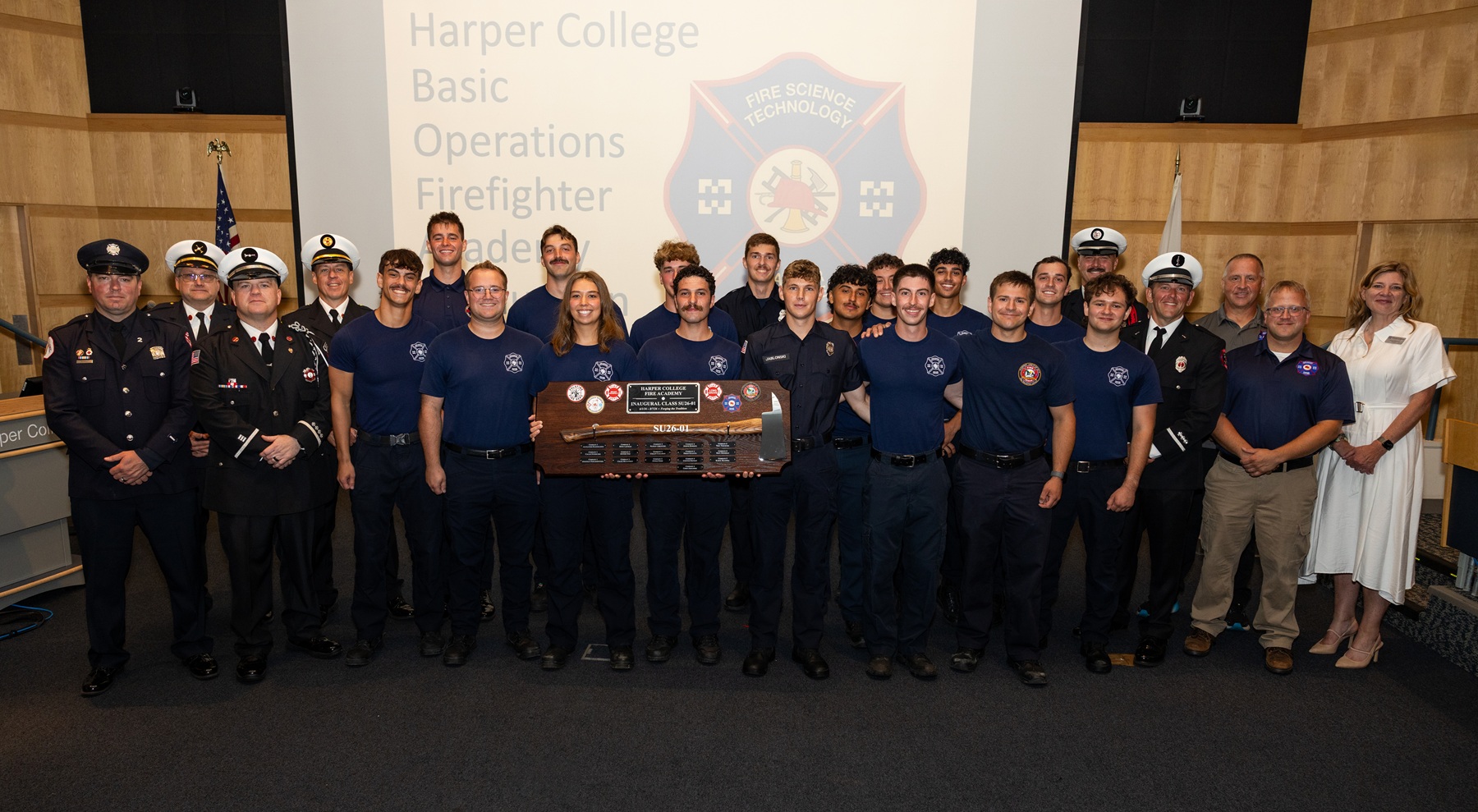
The nine-week academy is the limited-enrollment component of Harper’s new Basic Operations Firefighter Certificate program. It is one of only a few in the area that accept non-affiliated students, along with those who have already been hired by a fire department.
The academy’s curriculum integrates classroom instruction, firefighter skill development, hazardous materials operations and live-fire evolutions and is aligned with requirements established by the Office of the Illinois State Fire Marshal. Students who successfully complete the required courses are eligible to test for state Basic Operations Firefighter certification.
Harper’s new Emergency Services Training Center became their training ground. The four-story fire tower allows students to practice skills in environments resembling single-family homes, apartment buildings, high-rise offices and other settings they could encounter as firefighters. Students and faculty can prepare and debrief in classrooms that are just steps away.
That variety – and the ability to repeatedly practice scenarios – stood out to Jonathan Podczerwinski, 24, of Mount Prospect.
“You are getting a ton more reps and repetitions than any other fire academy because of the way our facility is set up,” Jonathan recalled instructors telling the class. During one training day, he said, students completed 27 live-fire evolutions, resetting after each scenario and doing it again.
For the cohort’s valedictorian, 27-year-old Alexander Rahimzadeh of Buffalo Grove, one measure of the group’s progress was a particularly challenging forcible-entry door. Early in the academy, students struggled to breach it. By the final weeks, they were getting through using the techniques, tools, teamwork and communication they had practiced throughout the summer.
“You don’t step up to the occasion, you fall back on your training,” Alex said. “The more training you do, the better you’re going to do in those live situations.”
The students credited instructors from fire departments throughout the region with bringing current, real-world experience to academy training. Alex, Jonathan and Callie were impressed by the variety and depth of knowledge shared between the 16 experienced fire service professionals who taught the cohort.
“I’m extremely proud of how well the academy has gone. It’s a testament to our planning but also the quality of instruction we offer,” Bemis reflected, mentioning how the program was able to make full use of Harper’s new facilities. “And I’m so proud of this cohort, how hard they’ve worked and how they’ve grown this summer.”
Alexander Rahimzadeh (from left), Jonathan Podczerwinski and Callie Swierczek formed
Company 1 during Harper's first Fire Academy cohort at the college's Emergency Services
Training Center. All three spoke about the bonds they forged with each other during
the rigorous program.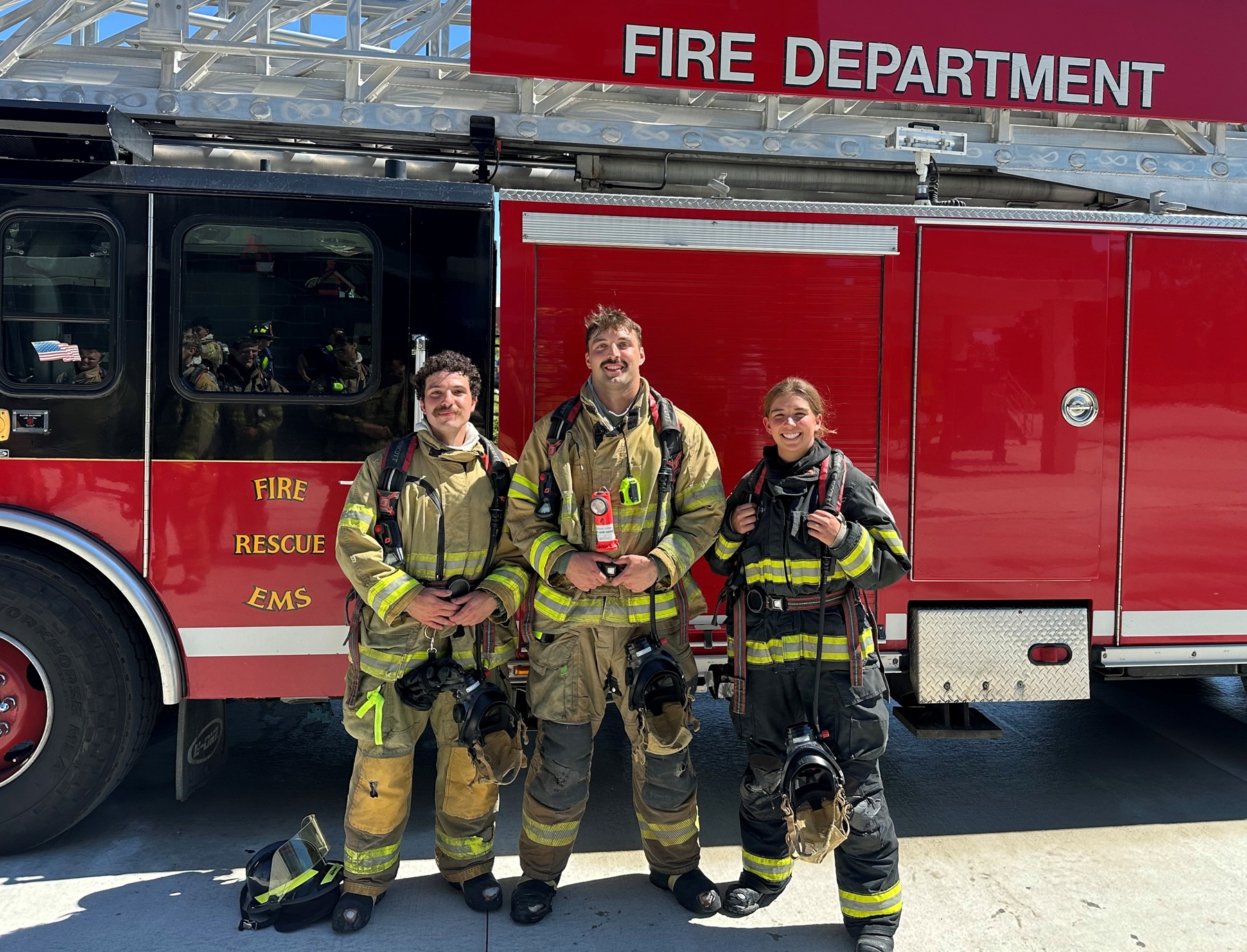
Academy students said that their abilities have grown, as have their relationships with one another
“Nine weeks ago, I did not know any of these people,” Callie said. “And now coming out of this, I consider these people lifelong friends. This is more than just a class. We’re building friendships, we’re building family.”
Those relationships reinforced one of firefighting’s central lessons: success depends on the team. Students learned each other’s strengths, helped classmates through difficult skills and pushed one another to improve. Harper also partnered with the Kenneth Young Center so the academy could also emphasize mental health.
“That was really cool for us to discuss what to do in a mental health crisis and how to watch ourselves and each other for mental health issues,” Alex said. “We are focusing on our mental health and our well-being rather than just being tough guys.”
Jonathan agreed: “It’s your brother and sister in the firehouse when we go on a call and something traumatic happens. I think the fire service is making it known that mental health is just as important as physical health and life safety.”
Harper's Fire Academy pairs training exercises with classroom lessons, such as those
taught by Norm Bemis, Harper's Fire Science Technology program coordinator.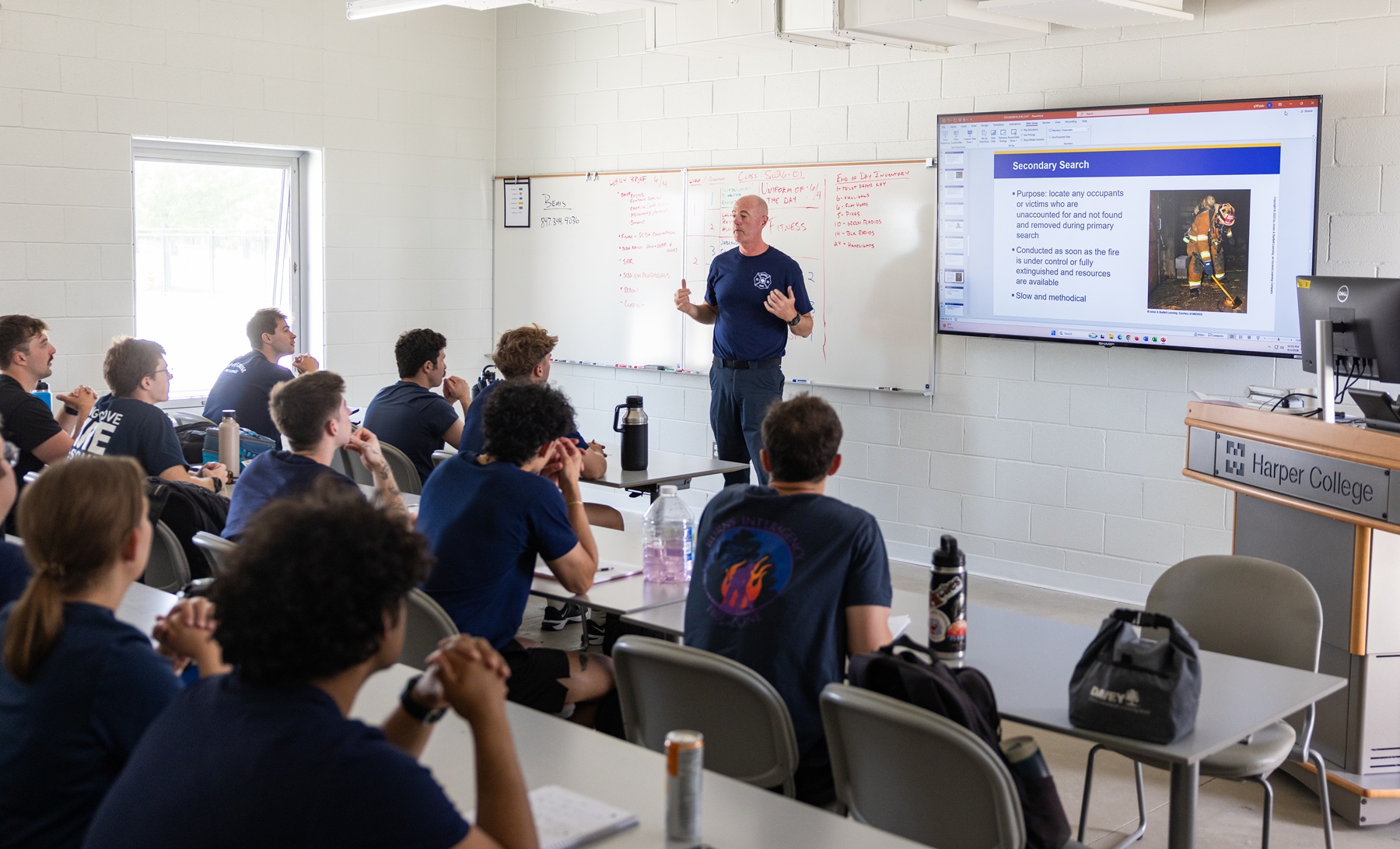
Now these academy graduates are carrying all of their newly honed skills toward careers in the fire service. Callie is continuing her Fire Science Technology degree at Harper; Alex is entering Harper’s Paramedic Certificate program based at Northwest Community Hospital; and Jonathan is set to intern with the Palatine Fire Department while pursuing firefighter and paramedic opportunities.
As members of Harper’s first academy at the Emergency Services Training Center, they know they’ve established a foundation for the cohorts that follow.
“Being able to look back in 20 years saying I was a part of the first group, that’s a super special thing to be able to say,” Callie said. “Having the chance to make history right now is what I really wanted to do.”
Visit Harper’s Basic Operations Firefighter Academy webpage to apply for a future cohort. In addition, new students may be eligible to have course fees and personal protective equipment covered because of a grant from Metallica’s All Within My Hands Foundation. Learn more.