
Harper College will be closed on Monday, September 7, in observance of Labor Day.

Antique Map of North Africa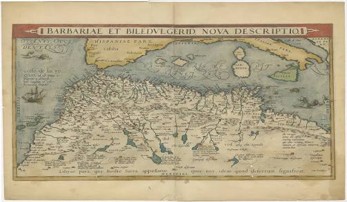
When Islamic armies from the Arabian Peninsula swept through North Africa in the 7th century C.E. and eventually conquered the region, their empire encompassed nearly 6 million square miles of land and stretched from modern-day India to Spain. Colloquially, they divided their empire into two regions – in Arabic, the Mashreq (“The Place Where the Sun Rises”) in the East and the Maghreb (“The Place Where the Sun Sets”) in the West. The Maghreb region typically is considered modern-day Morocco, Algeria, Tunisia, Libya, and Mauritania. But the Islamic Empire that was established in the 7th century was not the first empire of the Maghreb region, nor would it be the last.
City of Carthage aqueduct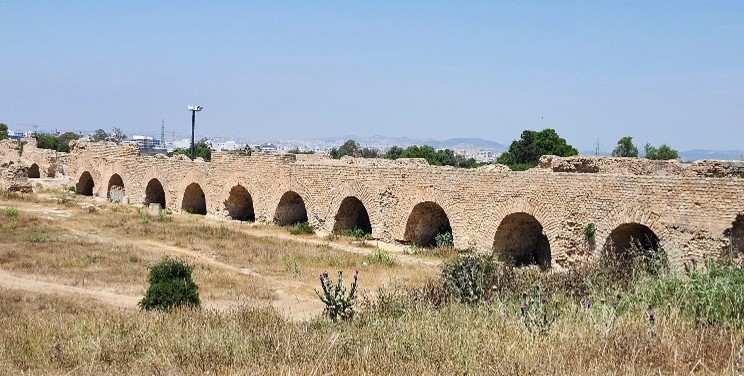
In 814 B.C.E. a group of Phoenicians (aka Canaanites) fleeing modern-day Lebanon landed on the Mediterranean Coast of Tunisia. There they founded what they called “New City” in their Punic language, better known today as Carthage. Bringing with them the world’s first phonetic alphabet, they would later add vowels to the Phoenician script and it would become the basis for the Latin alphabet. Already skilled naval engineers and merchants, by 300 B.C.E the Carthaginian Empire quickly expanded to cover North Africa from Libya to Morocco, and included parts of southern Spain and many of the large islands of the Mediterranean. Ancient historians considered Carthage to be one of the wealthiest cities in the world and a major hub of international commerce and travel. Surrounded by more than 23 miles of thick walls, at least 500,000 people lived within their confines at its height (Some historians consider Carthage to be the 7th largest city of the ancient world). Although much of its wealth was gained from trade and the production of goods made from bronze, they were also skilled at agriculture using techniques such as crop rotation and irrigation. They even invented the first horse-powered mills to grind grain. Carthage was ruled by a council of wealthy merchants who would elect two Suffetes who shared executive and judicial power. The system was established by a written constitution, a contemporary of the more famous Spartan Constitution. The Carthaginians clearly separated political and military power/leadership and placed the military under civilian control. This was considered unique in the Ancient World. Much of what we know about Carthage’s history and political system comes from Aristotle’s Politics where he wrote about Carthage in contrast to the Greek city states of the time. Very few Carthaginian sources survived the repeated conquests of the Maghreb by later empires. Much of what we know about Carthage after the time of Aristotle (384-322 B.C.E.) comes from Roman sources. And given that the Carthaginians and Romans were rivals and regularly at war, the anti-Carthaginian bias in these sources is evident and must be considered when writing Carthage’s history.
As the Carthaginian Empire weakened in the 3rd-century B.C.E. due to repeated wars,
a Berber warlord from modern-day Libya united several nomadic tribes with the help
of the Roman General Scipio Africanus. This became the Empire of Numidia, which stretched
from Libya through Algeria from 202-46 B.C.E. The Numidians were considered some of
the best cavalry soldiers of the Ancient World. They fought on horseback without saddles
or bridles and relied on speed and accuracy with their javelin attacks to overwhelm
their opponents. They also trained elephants to be used in war and as draft animals.
The Numidians were mainly pastoral and nomadic, but they did found several cities
including Hippo and had successful agriculture, particularly wheat. Their capitol
city was Citra and they constructed large, elaborate tombs and mausoleums for their
nobility across much of the Maghreb, including a famous tomb on the island of Djerba.
They fought both for and against Rome and Carthage at different points in history
and were eventually conquered by the Romans in 46 B.C.E.
Roman Amphitheater, El Jem, Tunisia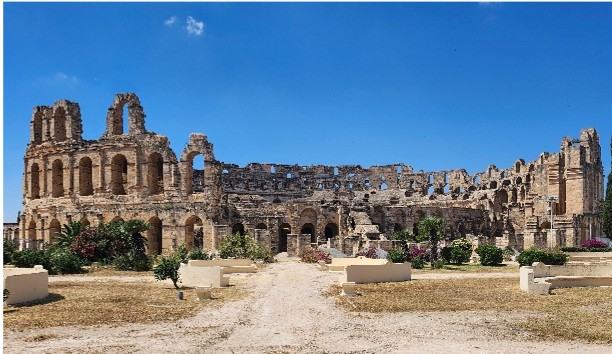
Roman city of Dougga, Tunisia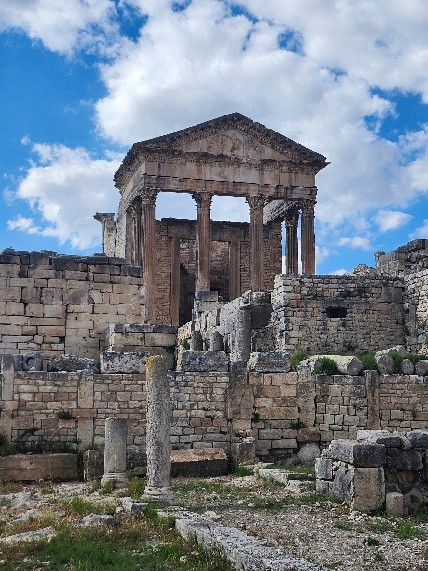
Between 264-146 B.C.E., the Carthaginians fought a series of wars against the Roman Empire for control over the Mediterranean region. These wars were known as the Punic Wars. In 146 B.C.E. Roman armies and their Numidian allies ended a 3-year siege of Carthage. The city was sacked, the people were slaughtered and enslaved, and much of the city’s architecture was left in ruins. Rome’s control of the Maghreb region would eventually last until the late 5th century C.E. The Maghreb was governed by a Roman governor during this time. The Romans built an extensive road network in North Africa, including the “Carthaginian Trail” that connected the Atlantic Ocean to the Nile River, to connect their settlements and facilitate trade. North Africa was considered the breadbasket of the Roman Empire, providing Rome with grain and olive oil. Christianity arrived in the Maghreb in the 2nd century C.E. and became the state religion in 380 C.E. The Maghreb would eventually produce more than 700 Christian bishops and more than a dozen officially recognized saints while under Roman rule.
In the summer of 365 C.E., a massive tsunami struck the coast of North Africa. The huge wall of saltwater devastated coastal settlements and caused near-total crop failure. The resulting destruction and famines greatly weakened the Roman Empire and its hold on the Maghreb. Over the next century the region was ripped apart through internal revolts and humanitarian crises as the Roman Empire never fully regained its previous glory. In 479 C.E. Germanic armies called the Vandals invaded the Maghreb and Rome’s control over the Maghreb was lost. The Byzantine half of the Roman Empire based in Constantinople (modern-day Istanbul) would briefly reconquer the region in the 6th century C.E., but the arrival of Islamic armies from the Arabian peninsula put an end to Roman/Byzantine rule in the 7th century.
Christian Baptismal Font, Bardo Museum, Tunis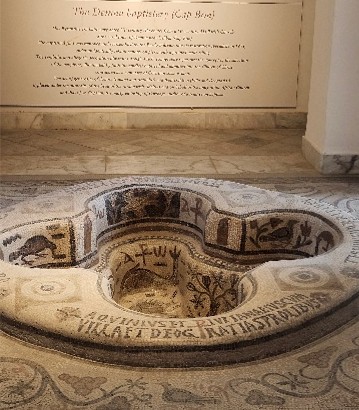
By 642, Muslim armies of the Rashidun Caliphate had conquered Egypt and turned their attention towards the Maghreb. Muslim historians call this “The Conquest of the Seven Abdallahs” after the seven successive generals who all shared the same first name. In 647 at the Battle of Sufetula (modern Tunisia) the Byzantine forces were routed and the path was cleared for Islamic expansion across the region. By 705, the Byzantines had completely abandoned North Africa; Carthage was destroyed (again), and the city of Tunis had been founded as the new Islamic capital in the region. During the Islamic conquest, in 670, the Great Mosque of Kairouan was completed, although extensive building and expansion continued until 774. It remains one of the largest Islamic monuments in North Africa and (one of) the oldest surviving mosques in the Maghreb. The Great Mosque became one of the centers of Islamic scholarship and education as one of the world’s first universities and one of the great libraries of the Middle Ages. Over the next 200 years, the people of the Maghreb adopted Islam as the predominant religion of the region. There was a large emigration and some persecutions of Catholics and Jews, but the conversion to Islam was largely done without military force. Christian and Jewish enclaves, particularly in larger cities, did continue and in some cases flourish in the Maghreb for centuries. Political control of the region would change hands numerous times over the following 7 centuries, but the various dynasties all maintained an Islamic orientation.
City of Sbeitla, Tunisia. The Battle of Sufetula was fought outside its walls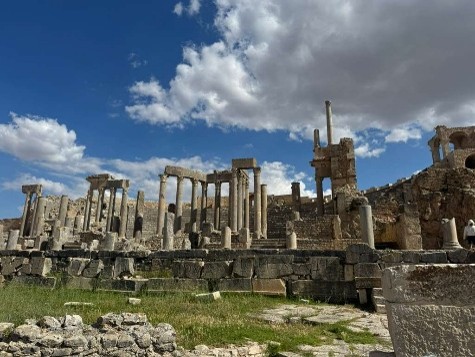
The Great Mosque, Kairouan, Tunisia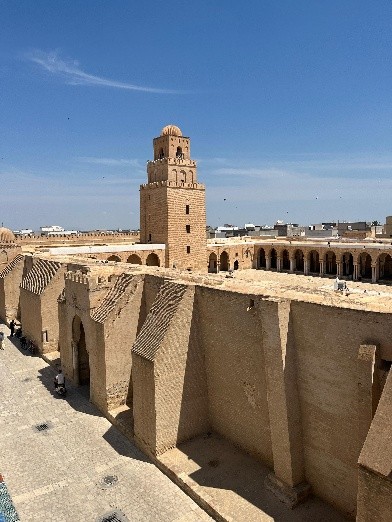
In the 7th century C.E., the Umayyad dynasty made the Maliki school the official basis of law codes in the Maghreb. The influence of the Maliki school remains a strong influence to this day. The Maliki school is one of the four major schools of religious thought in Sunni Islam. In brief, the Maliki school interprets Islamic law based on three major criteria: 1) The Practice of Medina (that the Islamic community in Medina descended from The Prophet is the most authentic version of Islam) 2) Public Interest (That judges should heavily weigh community welfare in their decisions), and 3) Local Customs (Community traditions are valid bases for judicial decisions). In addition to spreading Islam, the Arab conquests unified the region linguistically. New water management techniques brought from the Arabian Peninsula allowed new crops to be introduced to North Africa, particularly citrus, cotton, and sugarcane. A thriving trade developed between North Africa and the Levant. Islamic art and sciences flourished in Islamic universities, particularly in Al Fustat in Egypt, the Great Mosque in Kairouan, and the University of Al-Qarawiyyin in Fes (recognized by UNESCO as the oldest continually operating degree-granting university in the world today).
University of Al-Qarawiyyin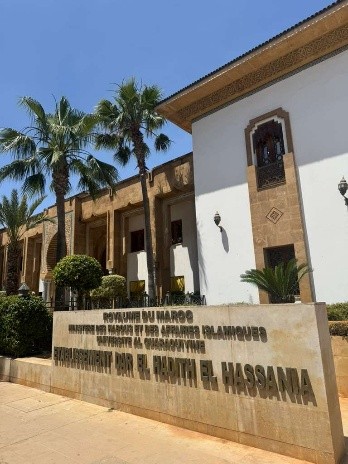
Chellah archeological site, Rabat, Morocco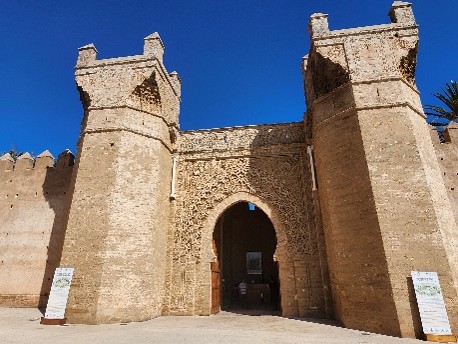
In the 1500s, the Ottoman Empire began to systematically conquer North Africa. Sultan Selim I saw the conquest of North Africa as a necessary way to check the growing power of the rival Spanish Empire. The Ottomans conquered Egypt in 1517, followed by Algeria (1529), Libya (1551) and Tunisia (1574). Although the Ottomans never conquered Morocco (a source of national pride), they did conquer and control the most important city of Fes on and off for 200 years. The Ottomans established a Turkish ruling class to govern their provinces in North Africa but largely allowed local traditions and laws to persist. They introduced new architectural styles, including pencil minarets and grand domes on mosques and official buildings. The Ottomans are blamed for greatly expanding the sub-Saharan slave trade, bringing more than 1.4 million enslaved peoples into the Mediterranean region from Central and Western Africa. The Ottoman Empire expanded North African trade as far east as China, introducing porcelain and gunpowder to the region.
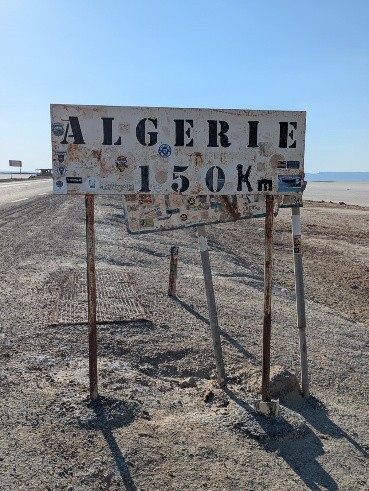 The French first attempted to conquer North Africa in the late 1790s under then General
Napoleon Boneaparte. Although Napolean’s attempt to conquer Egypt failed, it did launch
him all the way to French Emperor. It also started France’s goal of conquering the
Maghreb. The conquests started in 1830 with a French naval blockade of Algeria. Internally,
France framed this aggression as a “civilizing mission”, but it was also a time of
intense colonial competition between Britain and France and other European powers
to control as much of Africa and Asia as possible. It took 18 years for France to
gain control of coastal Algeria, and another five decades to effectively control the
interior. From 1848 until Algerian independence in 1962, Algeria was governed from
Paris, bypassing almost all forms of local control. Citing Tunisian support for Algerians,
France invaded Tunisia in 1881. France’s forces quickly swept through Tunisia, capturing
Tunis in less than 2 weeks. The Tunisian Bey (ruler) Muhhamed as-Sadiq was forced
to sign the Treaty of Bardo establishing Tunisia as a French Protectorate. This effectively
gave France control of Tunisia’s foreign, military, and economic policies while maintaining
a façade of Tunisian sovereignty. It later came out that a secret agreement was made
in 1878 between the French and the British in which Great Britain would recognize
French control of Tunisia in exchange for France’s recognition of British control
of Cyprus.
The French first attempted to conquer North Africa in the late 1790s under then General
Napoleon Boneaparte. Although Napolean’s attempt to conquer Egypt failed, it did launch
him all the way to French Emperor. It also started France’s goal of conquering the
Maghreb. The conquests started in 1830 with a French naval blockade of Algeria. Internally,
France framed this aggression as a “civilizing mission”, but it was also a time of
intense colonial competition between Britain and France and other European powers
to control as much of Africa and Asia as possible. It took 18 years for France to
gain control of coastal Algeria, and another five decades to effectively control the
interior. From 1848 until Algerian independence in 1962, Algeria was governed from
Paris, bypassing almost all forms of local control. Citing Tunisian support for Algerians,
France invaded Tunisia in 1881. France’s forces quickly swept through Tunisia, capturing
Tunis in less than 2 weeks. The Tunisian Bey (ruler) Muhhamed as-Sadiq was forced
to sign the Treaty of Bardo establishing Tunisia as a French Protectorate. This effectively
gave France control of Tunisia’s foreign, military, and economic policies while maintaining
a façade of Tunisian sovereignty. It later came out that a secret agreement was made
in 1878 between the French and the British in which Great Britain would recognize
French control of Tunisia in exchange for France’s recognition of British control
of Cyprus.
France first turned its attention to Morocco in 1856 with the Franco-Moroccan War. Although Morocco maintained its independence, Morocco was forced to give France major concessions on trade policy. Throughout the second half of the nineteenth century, Morocco consistently had to defend itself against incursions from France, Britain, Spain, and the Ottomans. Because of cost of defending itself against these conflicts and the various trade concessions that were extracted, by the early 20th century Morocco had accrued a crippling national debt. Using this debt and the threat of continued invasions as leverage, the French effectively forced the Sultan of Morocco Abd al-Hafid to sign the Treaty of Fes in 1912, ostensibly to preserve Morocco’s independence. Sultan Abd al-Hafid immediately abdicated after signing the treaty. The treaty gave the French the right to militarily occupy certain key regions of Morocco and gave the French Resident-General final authority on all Moroccan foreign affairs as well as economic policies. These territorial acquisitions all but guaranteed the Ottoman Empire's alliance with Germany and the Austrian Empire during World War I. French control of North Africa faced massive internal resistance in all these colonies and was maintained with extreme violence and military force. French became the dominant language of the ruling class during these occupations. “European quarters” were built as the upscale neighborhoods in the large cities to accommodate this ruling class. By the time of World War II, more than 1 million French emigres lived in North African colonies. The French invested heavily in mining and built rail networks to deliver these resources to newly improved port cities and then on to French factories. The French also built parallel secular French school systems alongside the existing Islamic schools. French medical and sanitation advances are credited with an early 20th-century population boom in the region.
French garden, Rabat, Morocco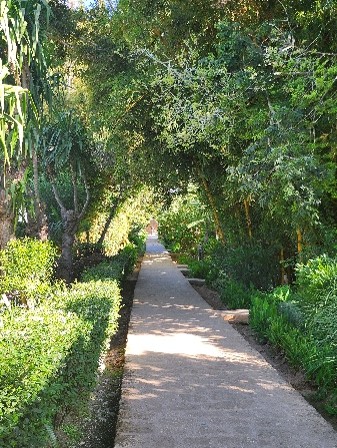
Port of Tangier, Morocco (Spain in the background)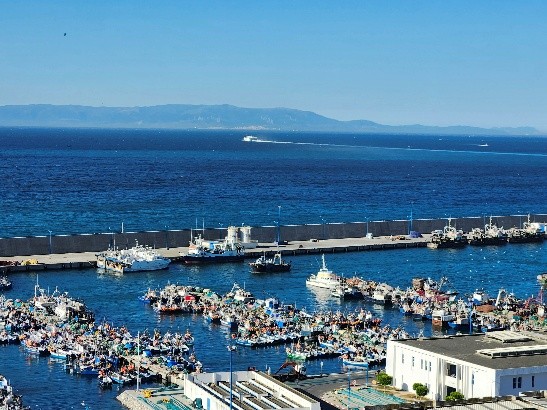
North Africa played a key role in the battles of World War II. The North African Campaigns were vital to the Allied War efforts, particularly in maintaining the flow of oil and ore to Allied countries. The invasions of Sicily and then Italy in 1943 were also launched from North Africa, opening up a critical new front in the European Theater. But the damage caused by European wars in North Africa and the stark economic inequalities of colonization made the Europeans increasingly unwelcome by the native people of the Maghreb. And although the Allied nations were victorious, the nations of Europe endured tremendous destruction during the war. In part because of Europe’s weakened condition and in part inspired by renewed philosophies stressing freedom and sovereignty after World War II, the colonies of the world sought independence in the decades following the war. The nations of the Maghreb were part of this decolonization movement. Morocco, under Sultan Mohammed V, formally declared its independence even before the war ended in 1944. The French exiled the Sultan to Madagascar. The people of Morocco formed an independence party and agitated for independence and the return of Mohhamed V for the next 12 years. France was forced to accept Morocco’s independence and the restoration of the Sultan in 1956. Spain continued to control the cities of Ceuta and Melilla, which is still a source of tension today. In Tunisia, independence was spearheaded by a man named Habib Bourguiba and the Neo-Destour (Constitution) Party. In 1952, when attempted negotiations with the French failed, Bourguiba and the Neo-Destour began a guerrilla campaign against the French in Tunisia. By 1956, France was forced to concede Tunisian independence. Bourguiba was elected the first president of an independent Tunisia that same year.
World War II American Cemetery, Tunisia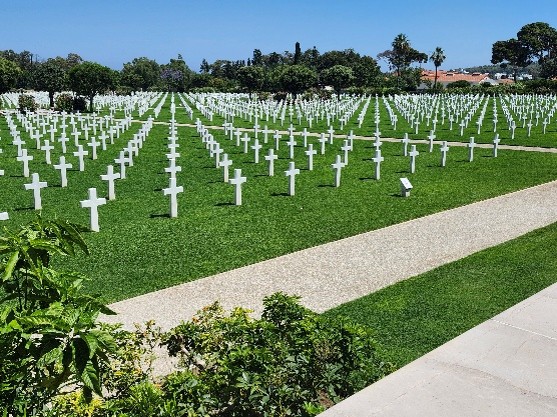
Gates to Moroccan National Palace, Fes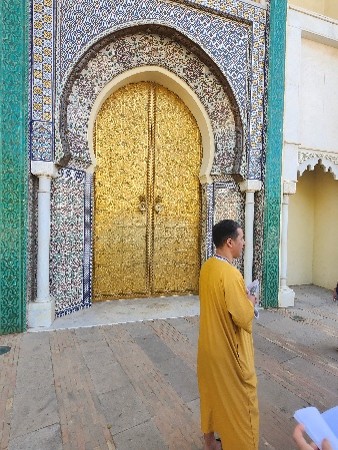
Statue of Habib Bourguiba, Tunis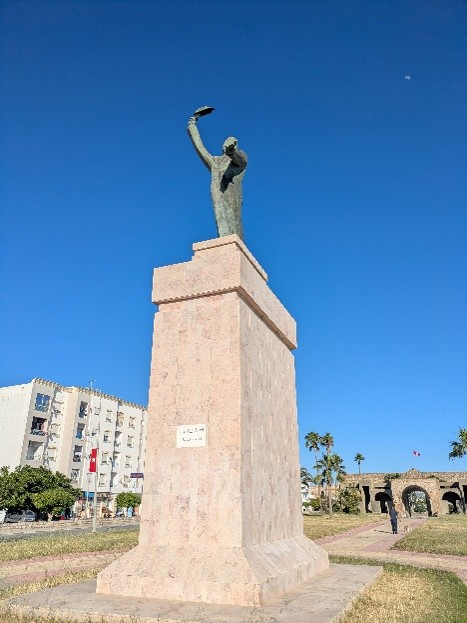
Algerian nationalists also began demanding independence at the close of World War II. In 1945, the French massacred participants in a parade calling for Algerian independence, known as the Setif Massacre. The French tried to then appease the increasingly hostile Algerians with a series of mild reforms that failed to give native Algerians the equality and voice they were demanding. The Algerian National Liberation Front (FLN) officially launched a war for independence in 1954. Eight years of the some of the most brutal conflict ensued. War crimes were committed by both sides, including civilian massacres, summary executions of POWs, torture, rape, and use of illegal chemical weapons. Nearly 1 million Algerians were killed (compared to about 35,000 French) and another 2 million were interned in concentration camps and still the Algerians fought on. By 1962, the world’s support for Algerian independence and the increasingly unpopularity of the war in France forced President Charles De Gaulle to accept Algeria’s independence. The Evian Accords were approved by 91% of the French electorate and 99.7% of the Algerian voters. July 5th is celebrated as Algerian Independence Day. By the end of summer 1962, the last empire in North Africa was over.
The Maghreb has been a battleground for Empires for nearly 3,000 years. These empires
have left a fascinating history and a diverse culture in the region. The people of
North Africa shared connections with people from sub-Saharan Africa, the Middle East,
Europe, and Asia long before globalization made the world a much smaller place. These
empires have left both lasting monuments and deep scars on the land and the people.
While it is impossible to adequately give a complete summary of 3,000 years of history,
my hope is this brief summary helped in some small way give some understanding of
a complex history of an exciting region of the world.