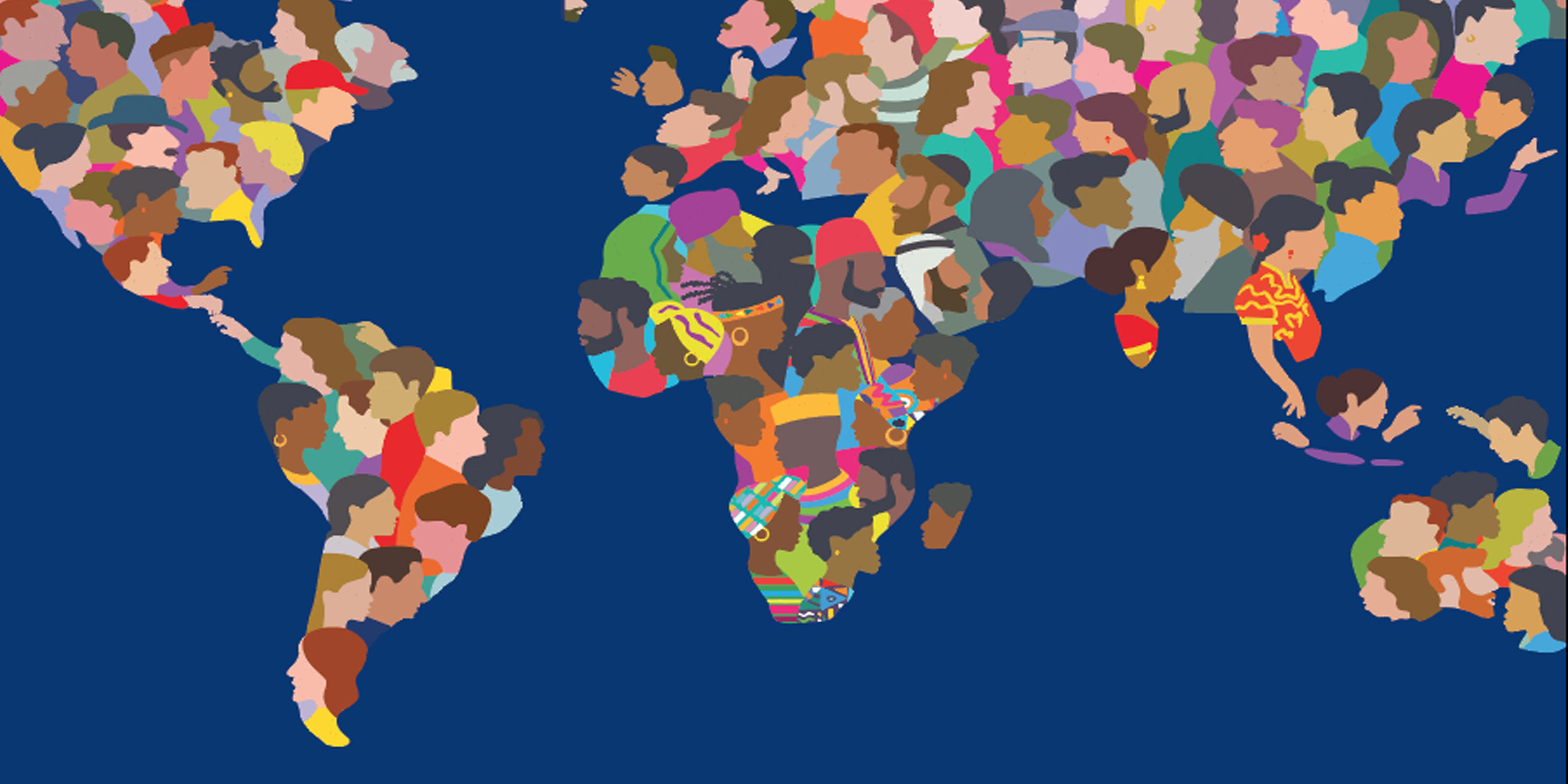
"You have to take ownership and leadership of tomorrow. For that to be possible, you
have to strengthen your capacity and widen your vision as a global citizen." - Ban
Ki-moon
The Global Scholar Distinction program gives you an opportunity to explore intercultural
and international perspectives as you pursue your major at Harper College. It is
designed to expand your awareness of global systems, the interdependence of cultures,
sustainable development, and global justice, equity and peace. At completion, you'll
be rewarded with a graduation distinction in recognition of your accomplishment. No
matter your field of study, this distinction helps you build skills to be an agent
of change in the world.
How to Become a Global Scholar
Complete three qualifying classes that may already be a part of your degree plan.
Upon completion of at least two qualifying classes, enroll in CAP 201: Social Transformation
Capstone (2 or 3 credits) and work on a capstone project under the guidance of a faculty
mentor. Visit World Cultures and Diversity Requirements for a list of qualifying courses.
Advantages
Work closely with your Harper faculty mentor and support network from start to finish
Immersion into different cultural contexts which can open doors to future employment,
scholarship possibilities, and an enriched higher education experience
Gain a deeper understanding on how to be an engaged global citizen and the interconnectedness
of world systems
Gain an understanding of intercultural communication and sociolinguistic awareness
Get a competitive edge when highlighted on your resume
Receive an official designation on your academic transcript and diploma. Recognized
with a regalia stole at graduation.
Questions?
Contact the Faculty Coordinator, Daivd Richmond by email (drichmon@harpercollege.edu) or by phone 847.925.6845. While a recommendation isn't needed, faculty and staff
are invited to recommend students who would embrace the Global Scholar experience.
Submit the Global Scholars Distinction Faculty Recommendation Form to recommend a student for the program.
We're excited to work with you as you earn the Global Scholar Distinction. Program
requirements:
Grade of C or better in 9 hours of interdisciplinary academic coursework (List of
approved courses below.)
Minimum 2.0 cumulative GPA
Completion of CAP201: Social Transformation Capstone, where you will complete a capstone
project proposal and independent study project with support from your faculty mentor
CAP 201: Social Transformation Capstone (2 or 3 credits)
Once you have completed 2 required courses, you are eligible to enroll in CAP 201
for either 2 or 3 credits. Both options involve developing an e-portfolio, reviewing
and writing reflections on case studies, class participation, a capstone project proposal,
and a final capstone project. The difference between the two sections is that the
3 credit hour course involves a service-learning component, where you complete some
type of community service with an organization, while the 2 credit hour course does
not include this service learning component.
Enrollment in the CAP 201 course requires permission from the Faculty Coordinator,
David Richmond (drichmon@harpercollege.edu).
What you'll learn:
Describe the interdependence and interconnectedness of world systems (e.g., financial,
technological, economic, political, religious, etc) and their components (e.g., nations,
ethnic groups, social classes, etc.).
Explain basic information about other cultures (e.g., their histories, values, politics,
economics, communication styles, values, beliefs, and/or practices).
Demonstrate an understanding of one or more aspects of the social, political, cultural,
economic, or historical context of at least one region of the world outside of the
United States.
Demonstrate competence in intercultural communication and/or sociolinguistic awareness
(e.g., acquiring basic local language skills, articulating differences in verbal/
non-verbal communication, adjusting one’s speech to accommodate individuals from other
cultures).
Analyze Western and non-Western cultural traditions in a world context or from a comparative
perspective.
Evaluate issues of social justice and sustainable development (e.g., identify ethical,
political, economic, social and/or environmental global challenges and evaluate local
and broader consequences of individual and collective interventions).