Harper College will be closed on Monday, September 7, in observance of Labor Day.

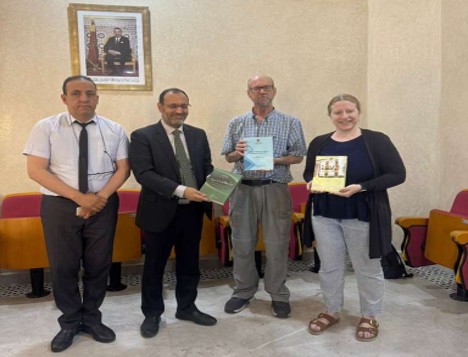
 Over tea and a variety of traditional Moroccan sweets, the Harper Field Seminar class
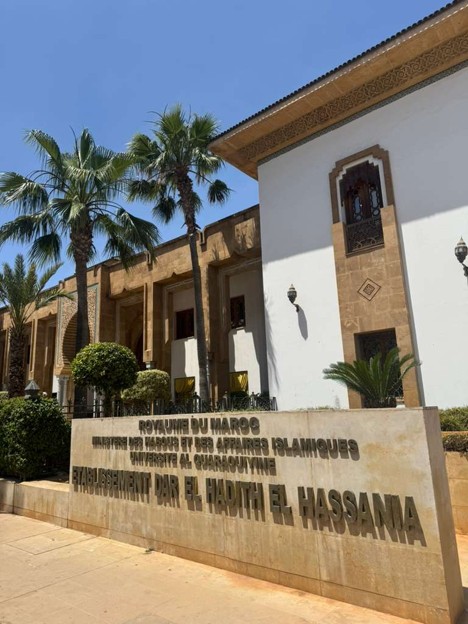
participated in a lecture and discussion with faculty and administration at Dar al-Hadith
al-Hasaniyyah, a premier higher education and scientific research institution founded
in 1964 by King Hassan II in Rabat, Morocco. Dar Al Hadith was born out of a royal
vision to train Islamic scientists capable of navigating both classical theological
traditions and the rapidly changing socio-political realities of today. Structurally,
the institute is deeply intertwined with Al-Qarawiyyin University in Fez—recognized
by UNESCO and the Guinness World Records as the oldest continually operating university
in the world. Operating under this prestigious umbrella, Dar al-Hadith acts as a specialized,
high-level research counterpart located in the administrative hub of Morocco, effectively
bridging historic, centuries-old legacy with contemporary global intellectual discourse.
Over tea and a variety of traditional Moroccan sweets, the Harper Field Seminar class
participated in a lecture and discussion with faculty and administration at Dar al-Hadith
al-Hasaniyyah, a premier higher education and scientific research institution founded
in 1964 by King Hassan II in Rabat, Morocco. Dar Al Hadith was born out of a royal
vision to train Islamic scientists capable of navigating both classical theological
traditions and the rapidly changing socio-political realities of today. Structurally,
the institute is deeply intertwined with Al-Qarawiyyin University in Fez—recognized
by UNESCO and the Guinness World Records as the oldest continually operating university
in the world. Operating under this prestigious umbrella, Dar al-Hadith acts as a specialized,
high-level research counterpart located in the administrative hub of Morocco, effectively
bridging historic, centuries-old legacy with contemporary global intellectual discourse.
Academic Structure, Exclusivity, and Global Footprint
Dar al-Hadith traditionally hosts a tight-knit body of around 300 students, men and women, from all over the world. This limited enrollment ensures that the university’s extensive resources, elite faculty, and institutional focus are poured entirely into cultivating top-tier scholars. Students travel from across the Arab region, Sub-Saharan Africa, Europe, Asia, and North America, to create a vibrant, multicultural microcosm of Islamic diversity within the campus.
Entry into both the undergraduate and postgraduate programs is highly competitive.
Prospective students must already possess a high-tier bachelor's degree from a recognized
university, demonstrate near-native fluency in classical Arabic, and pass a series
of difficult written and oral entrance examinations. These exams test applicants not
only on their knowledge of traditional religious sciences but also on their proficiency
in modern foreign languages and general contemporary history.
Once admitted, students matriculate into rigorous programs in religious studies, languages,
and the social sciences, and are taught in standard Arabic, the original source language.
Dar al-Hadith offers a variety of degrees including Bachelor's Degrees, Advanced Studies
Certificates, and a Doctorate in Islamic Studies and Comparative Religion.
Dar al-Hadith is deeply committed to international dialogue and cross-cultural exchange
and maintains extensive partnerships with colleges and universities worldwide. These
include academic collaborations and student exchange programs with renowned Islamic
institutions like Marmara University in Turkey, alongside joint research initiatives,
seminars, and theological colloquiums with various Western universities in Europe
and North America like Tubingen University in Germany and the Université Laval in
Canada. These partnerships ensure that students are not insulated from the outside
world but are actively engaged in global academic conversations.
Modernization and the 2005 Paradigm Shift
Historically, Dar al-Hadith was anchored primarily in classical Arabic linguistics and the Maliki school of thought, which reflects a practical, more community-centered vision of Islamic law, and is the primary Sunni legal and theological tradition of North Africa. While this provided a strong educational foundation, the leadership recognized that the 21st century required a more adaptive approach to religious education. As a result, the institution underwent a massive structural and pedagogical overhaul via Royal Decree in 2005.
A major logistical and symbolic milestone of this 2005 reform was the formal integration
of the Western (Gregorian) calendar into the university's academic scheduling. Historically,
like many traditional madrasas (educational institutions), scheduling revolved around
the Hijri (lunar) calendar. Transitioning to the Western calendar aligned Dar al-Hadith
with international higher education standards. This administrative shift made international
credit transfers, global research fellowships, joint degree programs, and cross-institutional
partnerships vastly smoother and more accessible for both faculty and students.
More importantly, the 2005 reform fundamentally re-engineered the curriculum to fuse
traditional Islamic sciences with modern secular disciplines. Alongside ancient texts
of fiqh (jurisprudence), tafsir (exegesis), and hadith (prophetic traditions), students
were now required to master:
Confronting Radicalism and the "Myth of Rigidity"
When asked about the contemporary geopolitical landscape and Muslim extremism, our presenters stressed that Dar al-Hadith plays a crucial theological role in countering Islamic radicalism and violent extremism, and the university curriculum is designed to directly dismantle the myth of rigidity in Muslim thought, which is the false notion that Islamic scholarship is inherently stagnant, uniform, dogmatic, or structurally incompatible with modernity and human rights. They also recommended a book to read, Covering Islam: How the Media and the Experts Determine How We See the Rest of the World, by Edward Said.
Our presenters further explained that the myth of rigidity is frequently perpetuated
by Western media, which influences the portrayal of Muslims worldwide and specifically
within the United States. Media narratives in the West often lean into a monolithic
representation of Islam, focusing on extremist fringes while ignoring centuries of
internal debate, critical reasoning, and intellectual pluralism. By showcasing a model
of education that embraces philosophy, critical critique, and historical-critical
methods of text analysis, Dar al-Hadith counters these external stereotypes while
simultaneously neutralizing extremist propaganda internally.
Crucially, the school's pedagogical philosophy explicitly states that its graduates
are not trained to be judges or rigid arbiters of law who hand down unyielding religious
edicts. Instead, the institution places its focus entirely on research, doctrine,
critical thinking, and reflection. By teaching students critical thinking rather than
just what to memorize (‘hifz’), Dar al-Hadith students view religious texts through
the lens of their historical contexts, allowing them to apply the core ethics of the
faith to modern issues like gender equality, bioethics, and civil governance without
falling into the traps of literalism or radicalism.
A Legacy of Scholarship
Morocco’s President of the government and President of the High Court are both graduates of Dar al-Hadith al-Hasaniyyah. Its alumni serve globally as diplomats, Islamic studies teachers, administrators, university professors, and policy advisors. By entering global spaces well-versed in both the depths of the Islamic golden age and the complexities of modern Western thought, these graduates will continue to bridge the gap between historic tradition and contemporary global society, rewriting the narrative of what it means to be an Islamic scholar in the 21st century.