
Harper College will be closed on Monday, September 7, in observance of Labor Day.

We were able to experience a Hammam in Morrocco, and the experience was unforgettable.
We were laid out on cool marble slabs, steam rising around us, when a woman with a rough sponge began to scrub away layers of dead skin. The Hammam follows a deliberate rhythm: exfoliation, soap and warm water, a mud treatment, a rinse, and finally a massage in a quieter room. The word itself derives from the Arabic root meaning "to heat," and there is something fitting about that, the idea that warmth, applied with intention, can prepare you for something.
But prepare you for what, exactly?
The Cleansed Ladies of Harper in Fez, Morocco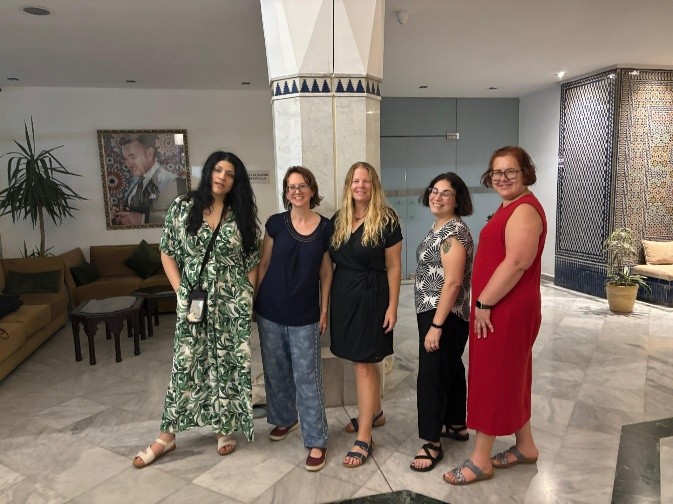
Before the advent of indoor plumbing, the Hammam was not simply a place to get clean. It was where people gathered, talked, and rested, functioning as the social infrastructure of Moroccan neighborhoods. The cleansing was almost secondary to the connection, and yet the two were inseparable. To be welcomed into a Hammam was to be welcomed into community.
Hammam in Testour, Tunisia 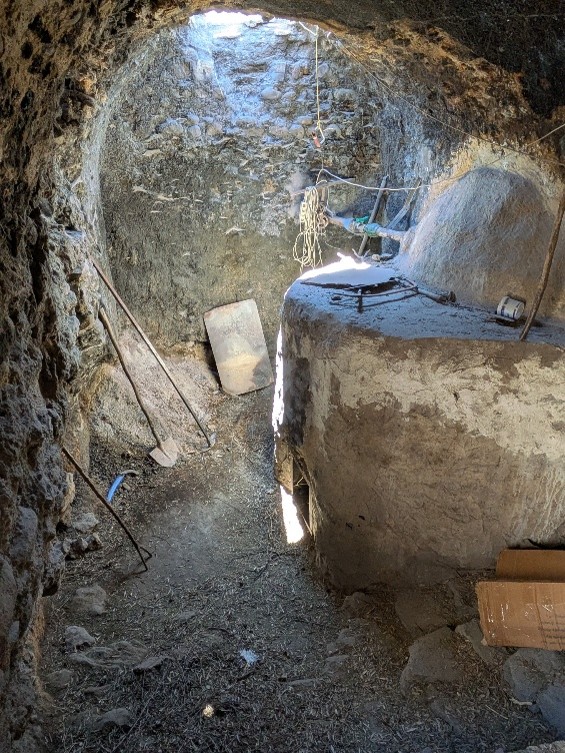
This stayed with me as I thought about the Jewish Mikvah, a ritual bath rooted in the same essential question: what does it mean to be truly clean? The Mikvah is used for spiritual purification across a range of significant moments, married women immerse following menstruation before resuming intimate relations; those converting to Judaism undergo full immersion as the final, formal step of their transition; and individuals may use the Mikvah to spiritually prepare for major holidays or to mark personal milestones, such as recovery from a serious illness. Despite their different cultural origins, the Hammam and the Mikvah share a common purpose, purification as preparation, whether for prayer, intimacy, transition, or celebration. Like the Hammam, the Mikvah is never simply about being clean. It is about arrival, the moment you step out of the water and into the next stop
The Roman Causeway built in late 2nd Century 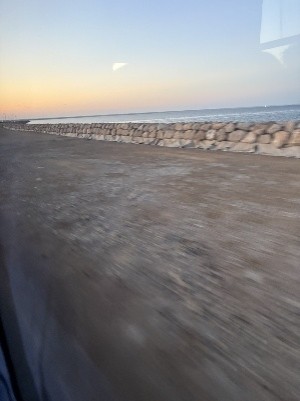
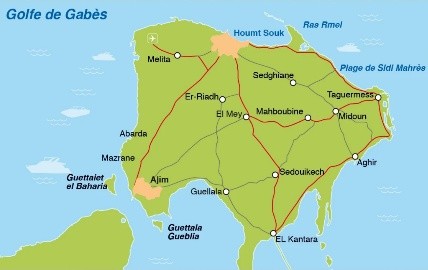 That brings us to our next stop, Djerba, Tunisia. An island only accessible via two
routes, a car ferry and our route, the Roman Causeway, an ancient roadway built in
late 2nd century. Djerba sits at the southeastern tip of Tunisia, and the island felt
held in a particular kind of stillness that day. Shops had closed early. It was the
eve of Eid al-Adha, the Festival of Sacrifice. The holiday is a day of deep gratitude,
an occasion for thanking God for spiritual blessings, seeking forgiveness, and asking
for continued guidance. At its center is the ritual sacrifice of an animal, traditionally
a sheep, with the meat divided deliberately into three equal portions: one for the
family, one for friends and neighbors, and one for those in need. That third portion
stayed with me, the structural insistence that celebration must include those who
are struggling. Gratitude, in this framework, is not passive. It requires action.
That brings us to our next stop, Djerba, Tunisia. An island only accessible via two
routes, a car ferry and our route, the Roman Causeway, an ancient roadway built in
late 2nd century. Djerba sits at the southeastern tip of Tunisia, and the island felt
held in a particular kind of stillness that day. Shops had closed early. It was the
eve of Eid al-Adha, the Festival of Sacrifice. The holiday is a day of deep gratitude,
an occasion for thanking God for spiritual blessings, seeking forgiveness, and asking
for continued guidance. At its center is the ritual sacrifice of an animal, traditionally
a sheep, with the meat divided deliberately into three equal portions: one for the
family, one for friends and neighbors, and one for those in need. That third portion
stayed with me, the structural insistence that celebration must include those who
are struggling. Gratitude, in this framework, is not passive. It requires action.
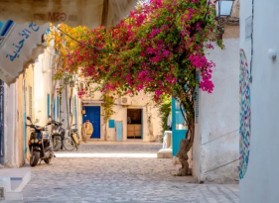
Djerba carries another layer of significance that extends far beyond any single holiday. The island has long been known as an "Island of Minorities," historically serving as a haven for marginalized and persecuted communities, among them Jewish people, Black Africans, and the Amazigh, the indigenous ethnic group of North Africa with their own distinct language and heritage that stretches back further than most recorded history.
Though the El Ghriba Synagogue, one of the oldest synagogues in the world, was closed for the holiday, the history it represents is ancient and remarkable. Some historians believe the first Jewish communities arrived in Tunisia following the destruction of the First Temple in Jerusalem around 586 BCE, a presence now estimated at over 2,600 years old. This predates the arrival of Islam, the Arab conquests, and even Roman influence in North Africa. We sat with the weight of that for a moment, the idea that Jewish life here is not a footnote to this region's story, but one of its oldest threads. Today, approximately 1,000 Jews remain in Djerba, one of the last significant Jewish communities on the continent. The El Ghriba Synagogue draws pilgrims annually from across North Africa, Europe, and Israel in observance of Lag b'Omer.
El Ghriba Synagogue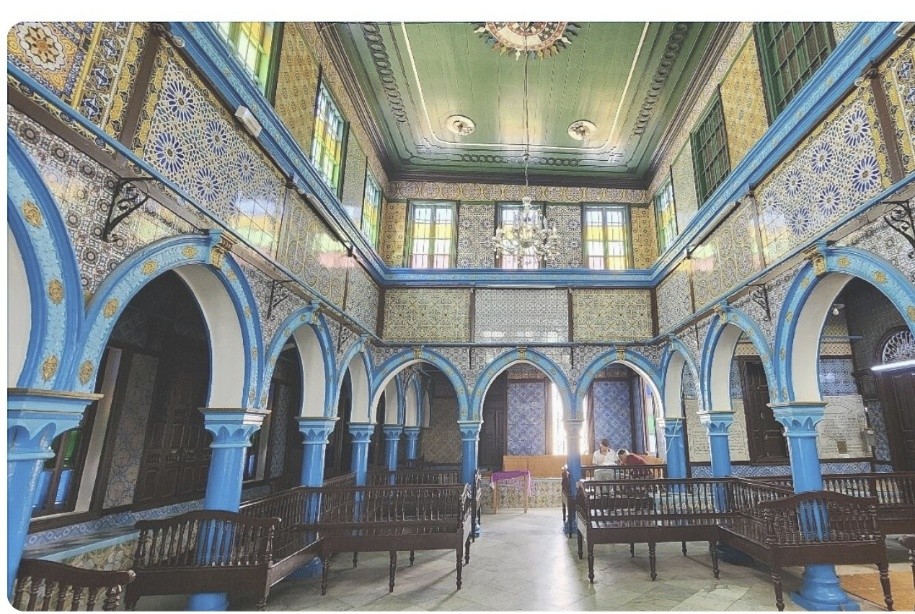
As it turned out, another celebration that afternoon arrived in a much smaller package. Nearly every restaurant in Djerba had closed for Eid, but one remained open in the island's historic Jewish quarter. There, we were served Brick, (pronounced breek), Tunisia's beloved pastry, impossibly crisp on the outside, filled with egg, tuna, capers, and herbs that somehow managed to stay delicate despite the crackling shell. It felt like another kind of ritual, a spiritual experience of the mouth. There was something quietly profound about eating one of Tunisia's most iconic dishes in a Jewish establishment on one of Islam's holiest holidays. No one announced the symbolism. No one needed to. Hospitality crossed religious boundaries as naturally as the meal crossed cultural ones. For a brief moment, the brick stand became its own place of purification, reminding us that food, like ritual, has the power to bring people together before we even realize we are being changed.
The King of Brick stand 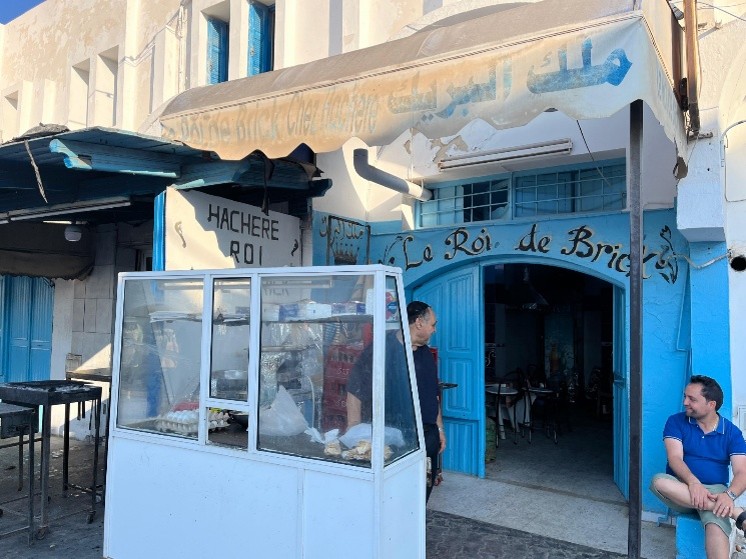
Feeding the ever-present Tunisian cats some left over brick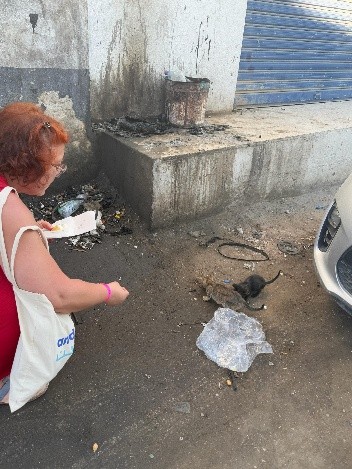
And perhaps that is the thread connecting all of it, the Hammam, the Mikvah, the brick and the island itself. None of them promise transformation without effort or belonging without history. They ask you to show up, to be present, and to emerge changed.