Harper College will be closed on Monday, September 7, in observance of Labor Day.

No journey to North Africa would be complete without mentioning the cats that lounge the streets, medinas, and even cafes. As a lifelong cat owner, one of the first things I noticed while traveling through Morocco and Tunisia was the cats. They were everywhere, resting in doorways, weaving through crowded markets, stretching out on stone walls, and quietly observing the flow of daily life. In some places, it seemed as though every street corner had its own feline resident. What struck me most was not just the number of cats, but how people interacted with them. Shopkeepers left out food, cafe owners tolerated them lounging near outdoor tables, and passersby often stopped offering a gentle pat or a scrap of food.
Tucked into a cool corner of Rabat, this calico cat seemed completely at home, a familiar
sight in Morocco, where cats are woven into the fabric of everyday life.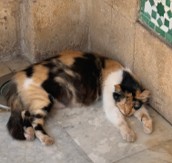
For visitors unfamiliar with the region, this relationship can be surprising. Yet the affection shown toward cats in North Africa has deep historical and religious roots. Cats have lived alongside people in this part of the world for centuries. Long before modern pest control, they helped protect homes, food stores, and markets from rodents. Over time, they became accepted members of the community rather than simply useful animals. Today, many of the cats wandering through the medinas of Morocco and Tunisia may not have owners, but they are rarely completely on their own. Entire neighborhoods often look after them.
Between the woven blankets and the busy souk, one sleepy customer found the perfect
resting place, Tunis, Tunisia.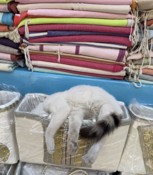
Religion plays a significant role in shaping these attitudes. In Islam, kindness toward animals is considered a virtue, and numerous traditions describe the Prophet Muhammad as someone who treated animals with great compassion. Stories about his affection for cats are well known throughout the Muslim world and are frequently shared from one generation to the next. Perhaps the most famous story is that of Muezza, the Prophet's cat. According to tradition, the cat was sleeping on the sleeve of his robe when he needed to leave. Rather than disturb the animal, he cut the fabric and left the cat resting peacefully. Whether told as history or as a lesson in compassion, the story continues to resonate because it reflects the values associated with the Prophet's treatment of animals.
At Chellah, where Roman ruins meet medieval Morocco, a small gray cat sat among the
ancient stones.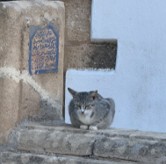
"A good deed done to an animal is as meritorious as a good deed done to a human being, while an act of cruelty to an animal is as bad as an act of cruelty to a human being." - Prophet Muhammad
As we explored the UNESCO World Heritage Site of Dougga, a curious cat appeared and
accompanied us through the ruins. Winding between Roman temples and ancient stones,
it seemed determined to lead our tour, reminding us that history in Tunisia is never
far from everyday life.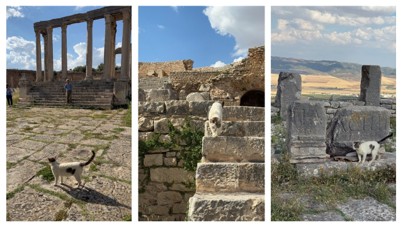
More firmly established in Islamic teachings are the many accounts emphasizing mercy toward all living creatures. The Prophet taught that caring for animals is rewarded and that cruelty toward them is unacceptable. These teachings have helped shape attitudes across Muslim societies for centuries.
While travelers hurry to their destinations, the cats of Tunisia have already found
theirs. Photo at a rest stop in Tunisia.
It is important to note that in Morocco, beginning in 2025, it is illegal to feed
stray animals, a law that has generated significant public concern. This regulation
is believed to be put in place to control the stray populations before the upcoming
FIFA World Cup games set to be hosted in Morocco in 2030. The law includes mandatory
registration of all animals, sterilization, and vaccination protocols. Failure to
comply with this legislation could mean fines of up to 500,000 MAD, or about $50,000,
with imprisonment for repeat offenders. Enforcement of the recent laws was not observed
during the field seminar, and there are currently no such laws in Tunisia.
Despite ongoing debates about managing stray animal populations, the cultural and religious values that encourage kindness toward animals remain evident throughout Morocco and Tunisia. Walking through the cities, it was easy to see these values reflected in everyday interactions between people and cats. The cats are not in between free to roam yet watched over by the people around them. This reflects a long tradition of respect for animals and a belief that compassion should extend beyond people to all living creatures. In many ways, the cats of Morocco and Tunisia are more than just a familiar sight, they are living reminders of those values.
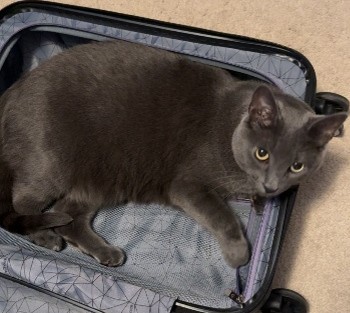
From the streets of Rabat to the ruins of Dougga, cats accompanied me throughout North
Africa. Back home, my own cat greeted me, inspecting my luggage for signs of where
I had been.