Harper College will be closed on Monday, September 7, in observance of Labor Day.
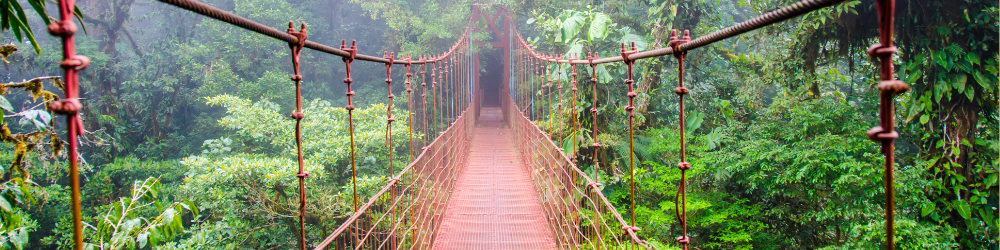
Progress and Preservation: Costa Rica's Environmental Future
Honors Study Abroad - Spring 2027
Travel Dates: March 19 - 27, 2027
Discover one of the most biodiverse countries in the world while earning Harper credit! Join a cohort of students traveling to Costa Rica to explore rainforests, diverse ecosystems, and local communities as you investigate the connections between environmental conservation, public health, and sustainable development. Through hands-on experiences and guided reflection, you'll connect biology concepts to real-world global challenges while gaining the knowledge and intercultural skills that come from learning beyond the classroom.
This program is offered in conjunction with two Honors courses: Biology 103 and Biology 230. Students may enroll in either course or both, depending on their academic goals. Because this is an Honors study abroad program, participants must be current Honors students or be eligible and willing to join the Harper College Honors Program prior to departure.
BIO 103 explores the relationship between people and the natural environment, using Costa Rica as a living classroom. Students will examine biodiversity, ecosystems, natural resources, human health, and population while considering how human activity, development, and culture affect the environment.
During the study abroad experience, students will have opportunities to connect these concepts to real-world environmental challenges in Costa Rica. They will observe diverse ecosystems and communities, consider how conservation and development intersect, and examine environmental issues through scientific, social, ethical, and cultural perspectives.
BIO 230 explores the world of microorganisms and their impact on human health, the environment, and society. Through the Costa Rica study abroad experience, students will connect microbiology concepts learned in the classroom and laboratory to the diverse environments, communities, and practices they encounter in-country.
Students will consider how microorganisms influence ecosystems, agriculture, food production, water and environmental quality, and human health. The experience will also encourage students to examine how climate, biodiversity, environmental conditions, and human activity can influence microorganisms and the spread and prevention of disease.

Cost: $4,000* ($3,200 w/ Honors scholarship)
Estimated program cost. Final cost may vary based on airfare, exchange rates, program enrollment, and other unforeseen expenses.
Cost Include: airfare, accommodation, entrance fees, insurance, ground transportation and most meals (8 breakfast, 7 lunches, and 4 dinners).
Cost does not include: tuiton and fees, miscelaneous, optional excursions, meals not specified.
This is an Honors-supported study abroad program. Students accepted into the program who are members of the Honors Program will receive an $800 scholarship. The scholarship will be applied to the program cost and distributed between the third and final payments.
Visit our Study Abroad Scholarships page for more information.
Additional Scholarship Available to This Program: The Authentica SEED ScholarshipStudying abroad shows you how other places solve problems you had assumed were unsolvable at home. The SEED Scholarship supports students who intend to bring something back.
Two $1,500 awards are made each year — $1,200 toward your program cost, plus $300 once you submit a short post-program report on your project — to students studying, interning, or researching abroad — with any program, any provider, in any country. You do not need to travel with Authentica, applying creates no obligation of any kind, and there is no application fee.
| Payment | Amount | Due Date |
|---|---|---|
| FIrst Payment - Deposit | $500 | November 1, 2026 |
| Second Payment | $500 | November 15, 2026 or upon acceptance |
| Third Payment | $1,500 ($1,100 with Honors scholarship) | December 15, 2026 |
| Final Payment | $1,500 ($1,100 with Honors scholarship) | January 15, 2026 |
Application deadline: November 1, 2026