
Harper College will be closed on Monday, September 7, in observance of Labor Day.
Career options 
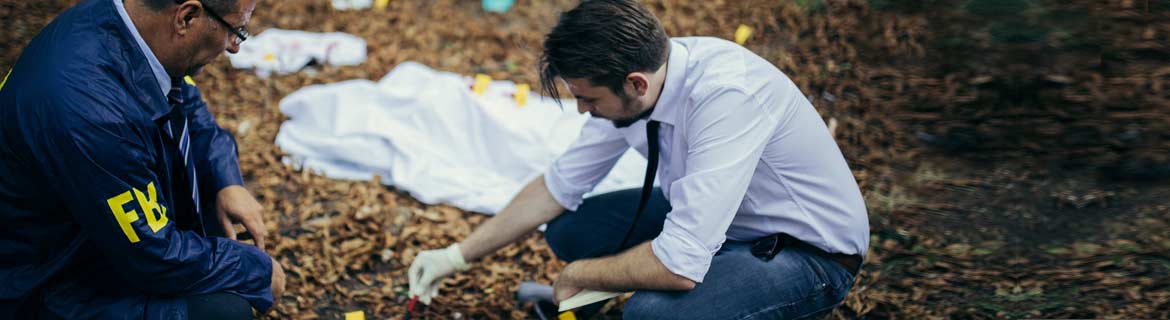
Prepare for a career in forensic science with this degree program. Forensic technicians are trained in identifying, gathering and preserving evidence, playing a critical role in the criminal justice system. As a student in this program, you’ll learn the legal and scientific aspects of evidence, methods of crime scene searches and procedures for locating and preserving evidence.
Take classes in fire behavior and combustion, criminal justice, chemistry, criminal procedures, hazardous materials, investigative process, leadership and ethics for law enforcement, forensics and more.
This 60 credit-hour program will provide instruction to students in the proper techniques of identifying, collecting and packaging physical evidence associated with crime scenes and understanding the importance of proper evidence handling. The forensic science technician is responsible for processing evidence at crime scenes, identifying, collecting, and preserving physical evidence to support law enforcement activities. Graduates may be employed as forensic technicians, property and identification custodians, arson investigators and investigators for local law enforcement and fire services, federal agencies, local, regional and national crime labs, as well as in private industry such as insurance companies, etc.
| Number | Course Title | Credits |
|---|---|---|
First Semester | ||
| A grade of C or better in all FIS, LEJ, and MTH courses is required for all students. | ||
| ENG 101 | Composition I | 3 |
| FIS 121 | Fire Behavior and Combustion | 3 |
| LEJ 101 | Introduction to Criminal Justice | 3 |
| LEJ 116 | Forensics I | 3 |
| Mathematics 1 | 3 | |
| Hours | 15 | |
Second Semester | ||
| A grade of C or better in all CHM and LEJ courses is required for all students. | ||
| ANT 215 | Introduction to Forensic Anthropology | 3 |
| CHM 100 | Chemistry for the Health Sciences | 4 |
| CHM 110 | Fundamentals of Chemistry | |
| ENG 103 | Technical and Report Writing | 3 |
| LEJ 217 | Forensics II | 4 |
| Hours | 14 | |
Third Semester | ||
| A grade of C or better in all FIS and LEJ courses is required for all students. | ||
| CIS 101 | Introduction to Computer Information Systems | 3 |
| FIS 132 | Hazardous Materials | 3 |
| FIS 210 | Fire-Arson Investigation2 | 3 |
| LEJ 202 | Criminal Procedures | 3 |
| LEJ 218 | Forensics III | 4 |
| Hours | 16 | |
Fourth Semester | ||
| A grade of C or better in all LEJ courses is required for all students. | ||
| LEJ 200 | Leadership and Ethics for Law Enforcement | 3 |
| LEJ 216 | Investigative Process | 3 |
| LEJ 295 | Forensics IV | 3 |
| PHI 101 | Critical Thinking | 3 |
| SOC 101 | Introduction to Sociology+ | 3 |
| Hours | 15 | |
| Total Hours | 60 | |
Placement into college-level mathematics without support. See the math placement grid for more information.
Prerequisite of FIS 100 will be waived for Forensic Science students.
This course meets the World Cultures and Diversity graduation requirement.
For more information about forensic science training at Harper College, contact Admission Outreach at 847.925.6700, or submit a request information form. You can also apply online.