
Harper College will be closed on Monday, September 7, in observance of Labor Day.
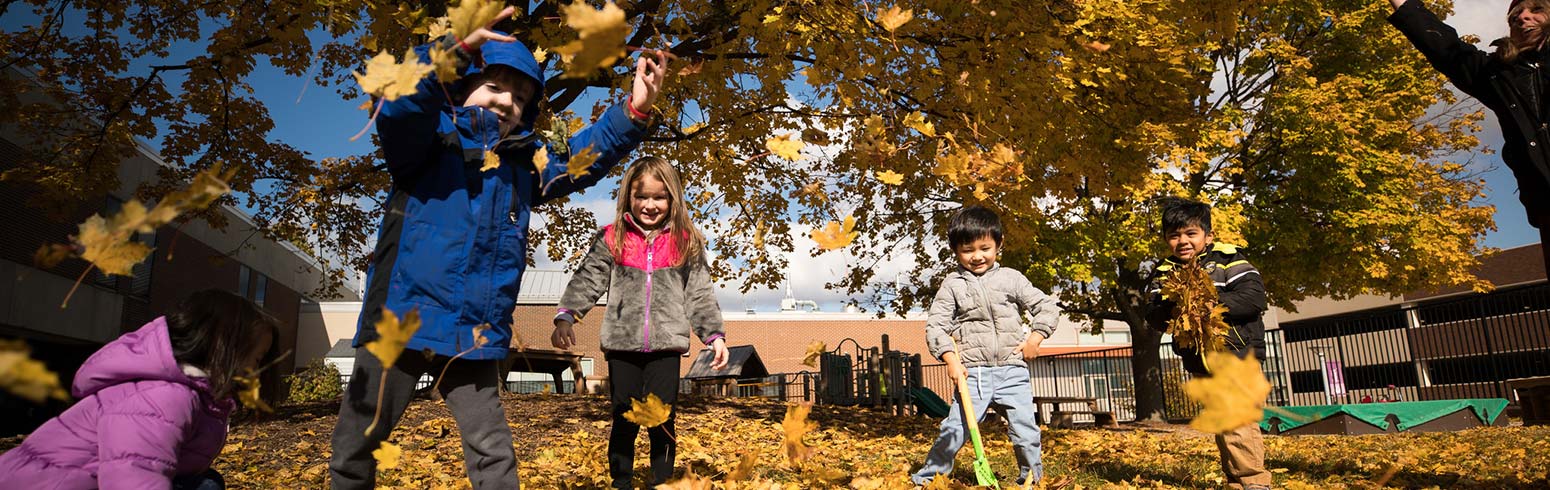
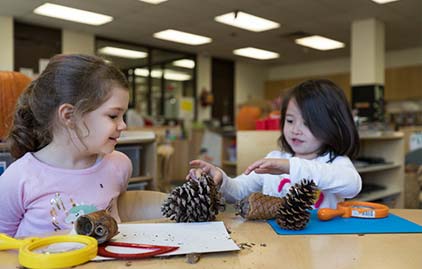
For more than 40 years the Early Childhood Laboratory School of Harper College has provided a warm, nurturing environment in which children feel secure and can learn and grow. The center provides an exemplary educational environment for young children ages 3-5 and serves as a model of teaching methodology for Harper's early childhood education students.
The Early Childhood Laboratory School offers an enriched learning environment and personalized care for your child. Full or half-day programs are available for children of students, faculty, staff and the community. The needs of young children are met with a child-centered curriculum designed to encourage safe exploration and discovery.
The classrooms are divided into interest centers and are designed to encourage children's learning through investigation, exploration and problem-solving.
To enroll in the program children must be 3 years old and fully potty trained.
Visit HighScope Preschool Curriculum to learn more about what we teach at the Early Childhood Laboratory and our pedagogical approach.
Our Student to Teacher Ratio is well above the average, with 4 adults for every 20 students. This award-winning facility has been caring for and educating children for more than 45 years.
The curriculum is based on the philosophy that young children learn through active exploration in an environment which is rich in materials and opportunities to converse, socialize, work, play and negotiate with others.
The classrooms are planned to encourage curiosity, exploration and problem-solving in an atmosphere of warmth, affection, and respect for each child.
Teachers plan experiences based on children's interests and appropriate educational concepts.
Children may work individually or collaboratively and may choose whether or not to participate in a project. Children are actively involved in experiences which include foundations of math, science, social studies, creative art, language arts, music, movement and dramatic play.
All interrelated aspects of the child's growth and development are considered - intellectual, social, emotional, physical and creative.
Activities, experiences, and teacher-child interactions are constantly being measured and evaluated in terms of the following programs goals.
School readiness is enhanced when children are provided with play-oriented, exploratory activities that allow them to interact, make choices, and participate at their own developmental level. This vision is central to our High Scope’s curriculum ideal of active participatory learning, which has five ingredients:
The classrooms learning environments are organized into interest centers and are designed to encourage children’s learning through investigation, exploration and problem solving. High Scope daily routine organizes the day’s events and it is the same every day, although time periods are occasionally altered to accommodate children’s interest and there are exceptions for field trips, celebrations, or other special events.
Plan – Do — Review
Is devoted to the sequence: planning time, work time and recall time.
Planning Time
Meeting in a small group, each child decides what to do during work time-what area to play in, what materials to use, and who else will be involved – and shares this plan with a teacher and other children in the group.
Work Time
Work time is when children carry out their plans, alone and/or with others and then clean up.
Recall Time
At recall time, children meet with the same teacher and small group of children with whom they planned to share and discuss what they did and learned during work time
Large Group Time
Those times when the entire class does something together. The children meet to share ideas and experiences, sing songs, perform finger plays and discuss topics for the day (message board) or playing outside
Small Group Time
During these times, teachers introduce children to new materials, ideas, and activities, which the children can then continue to explore during work time. The activities may include following curriculum content areas: Mathematics; Language, Literacy and Communication; Science and Technology; Social Studies; Physical Development and Health; Social Emotional and Approaches to Learning. Children meet with the same teacher and set of classmates during the year. This arrangement provides continuity and security for children and also allows the teacher to develop a thorough knowledge of each child in this group over time.
We keep in touch through newsletters, progress reports, and open houses. Parents are welcome anytime!
Participate in classroom activities with your child or use our state-of-the-art observation room. Equipped with cameras and microphones you may observe your child from behind a one-way mirror.
The Early Childhood Laboratory School of Harper College is licensed by the State of Illinois Department of Children and Family Services and accredited by the National Association for the Education of Young Children (NAEYC). The Lab School has received an award for Exemplary Practice from the Illinois State Board of Education and a Gold Circle of Quality from ExceleRate Illinois.
Harper's Student Parent Success Program is grand funded program that addresses financial barriers related to child care cost so students can focus on their studies. Apply for Student Parent Success Program (CCAMPIS Grand) by contacting ds36299@harpercollege.edu
Contact Stephanie Daron Paz
ds36299@harpercollege.edu
847.925.6863