Beyond Borders, Beyond Buzzwords: Results that Resonate in Global Education
Date: Friday, April 10, 2026
Tentative Time: 8:30 a.m. to 3 p.m.
Location: Harper College, Wojcik Conference Center
Harper College is proud to host the 17th Annual International Education Summit, featuring
special programming in collaboration with ICISP.
This year’s theme, “Beyond Borders, Beyond Buzzwords: Results that Resonate in Global
Education,” challenges us to move past rhetoric and highlight practices that truly
make a difference. We’re looking for proposals that showcase measurable outcomes,
authentic student impact, expanded access, and sustainable global engagement.
Theme tracks for this year’s Summit include Study Abroad, International Students &
Scholars, Technology, International Enrollment, and Internationalization at Home.
Submit a proposal to share your strategies, research, and success stories, then join
your colleagues committed to advancing meaningful global learning.
1.3 From Global to Local: Reimagining Internationalization with the UN Global Goals,
Camila Fernandez and Shamili Ajgaonkar (College of DuPage)
1.4 Applying ESL Pedagogies Outside the ESL Classroom Alexandra Swanson (College of
Lake County)
1.5 Better Together: Faculty-Advisor Collaboration for Study Abroad Access and Success,
Kim Jaeger, Katye Speer, and Anita Vaughan (Harper College)
11:15 am - 12:15 pm
Breakout Session 2
2.1 Internationalizing CTE and STEM: Pathways Through Study Abroad and Curriculum Design,
Nataliya Marchenko (Joliet Junior College) and Dawn Chambers (Illinois Valley Community
College)
2.2 Immersive Storytelling as Global Education: Decolonizing Narratives Through Community-Based
Performance,IlknurOzgur (Harper College)
2.3 Navigating Global Disruption: Strategies for International Student Success,Autym Henderson (National Louis University)
2.4 Humphrey Fellows panel: Farayi Machamire (in person), Eman Elkosary, Trang Thi Quynh Vu, and Jerome Kisting (Join Online)
2.5 Around the World Virtually, Tony Baracco (Oakland Community College)
12:30 pm - 1:45 pm
Lunch
Panel Discussion: International Educators at Community Colleges: Pathways, Purpose,
and the Future, Join Online
2 pm - 3 pm
Roundtables
a. Building Bridges: Designing a Truly Interdisciplinary Study Abroad Experience, Pardess
Mitchell, Edmir Wade, GerardoCruz(Harper College)
b. ICISPStudy Abroad in France,Jody Littleton (Parkland Community College)
c. ICISP Study Abroad Program to Salzburg, Austria,Amanda Cook Fesperman (Illinois Valley Community College)
d. Introduction to the ICISP Professional Exchange Program,Paul Edleman and 2-week exchange(Sauk Valley Community College) and Sangeeta Kumar (South Suburban College)
e. Beyond the Itinerary: Designing Transformative Faculty-Led Study Abroad Experiences,Matthew Yates (LearnFromTravel)
f. Global Justice Student Roundtable, Eric Bohman (Harper College) and students
3 pm - 4 pm
Launch reception for Center for Global Education and Engagement!
Session Information
9 am - 10 am: Expanding Global Opportunities on Your Campus Through ICISP
The Illinois Consortium for International Studies and Programs (ICISP)
The Illinois Consortium for International Studies and Programs (ICISP) is a network of higher education institutions committed to expanding access
to global education through shared resources, partnerships, and programs. By working
collectively, member institutions are able to offer a wide range of international
opportunities that may not be feasible independently, including semester and short-term
study abroad programs, faculty-led experiences, and professional exchanges.
This session is designed for faculty, staff, and administrators from both current
and prospective member institutions and aims to broaden awareness of ICISP beyond
the international education offices. Participants will gain insight into how ICISP
can support campus-wide internationalization efforts by providing accessible pathways
for students to study abroad, opportunities for faculty to teach or lead programs
overseas, and reciprocal professional development exchanges that foster global collaboration.
Through an overview of ICISP offerings and institutional examples, this session will
highlight how participants can actively engage with the consortium to enhance curriculum,
expand experiential learning, and build global competencies across disciplines.
Marie Lapidus is an Assistant Professor and Business Department Coordinator at Harper College,
where she brings more than 25 years of experience in business, marketing, and entrepreneurship
education. Her professional background spans entrepreneurial ventures, including running
her own retail business, as well as corporate roles in technology implementation,
training, and advertising. She holds dual bachelor's degrees in Political Science
and Economics from the University of Illinois Urbana-Champaign and an MBA in Management
Information Systems from DePaul University. She also earned a Master Online Teaching
Certificate from the University of Illinois Springfield and a Graduate Certificate
in Teaching Economics from the University of Illinois Chicago. As an immigrant and
former study abroad participant at the Sorbonne, Lapidus brings a global lens to her
work. Her recent initiatives include community-focused maker projects and advancing
internationalization at home through curriculum design, virtual exchanges, and interdisciplinary
collaborations.
Virtual exchanges offer powerful pathways for global learning, yet many educators
struggle to move beyond broad aspirations toward models that are practical, scalable,
and sustainable. This session showcases a series of fully online, asynchronous, four-week
virtual exchanges implemented in management courses. These exchanges connected Harper
College students with international partners in Mexico to explore global sustainability,
entrepreneurship, and intercultural collaboration through structured, outcomes-based
projects.
The presentation will highlight the essential tools, platforms, and design frameworks
that made the exchanges successful-including project templates, communication structures,
assessment rubrics, and strategies for fostering authentic engagement in asynchronous
environments. Participants will gain insight into how short-duration exchanges can
meaningfully expand access, deliver measurable learning outcomes, and integrate global
perspectives into existing curricula without adding complexity or cost.
Attendees will leave with concrete, adaptable resources to begin planning or enhancing
their own virtual exchange initiatives, regardless of discipline, class format, or
prior international partnerships.
1.3 From Global to Local: Reimagining Internationalization with the UN Global Goals,
Camila Fernandez and Shamili Ajgaonkar (COD)
Camila Fernandez is a Program Specialist at the Field Studies/Study Abroad/Global Education Office
at College of DuPage. She has more than 8 years of experience in the higher education
and non-profit sector, coordinating students' educational programs and planning and
executing community and fundraiser events. Skilled in project management and logistics,
Camila has successfully led the implementation of campus-wide in-person and online
tutoring programs, student training workshops, and Global Education programming on
campus.
Shamili Ajgaonkar is a Professor of Biology and the Faculty Chair for Global Education at the College
of DuPage. She believes that education should help harness our creative abilities
to learn to live on a crowded planet. Besides thinking about the meaning and place
of ecological systems in human society, she enjoys spending time with her family,
cooking, and being outside hiking, observing wildlife, and vegetable gardening.
As the world becomes increasingly interconnected, global education has become a vital
component of modern higher education, equipping students and our community with the
skills, perspectives, and knowledge needed to thrive in a global society. While field
studies courses and study abroad remain transformative high-impact practices, many
students face financial, professional, or personal barriers that prevent participation.
For these students, institutions must intentionally design accessible and inclusive
global learning opportunities that bring international perspectives into local spaces
and ensure that global engagement is not limited to travel.
This presentation explores practical strategies for advancing global education across
campus through initiatives implemented at College of DuPage. Central to this approach
is aligning curriculum and programming with the United Nations Sustainable Development
Goals (Global Goals), a shared blueprint of 17 goals and 169 targets aimed at advancing
human and planetary well-being. Through an annual series of events and interdisciplinary
collaborations organized around these goals, we demonstrate global thinking and intentionally
connect the individual to society and the local to the global.
The session also examines initiatives that promote global access to information and
critical thinking, including the celebration of Global Media and Information Literacy
Week to address misinformation and strengthen media literacy competencies.
A key component of campus internationalization includes providing logistical support
and funding for regional global education committees, Africa and African Diaspora,
Asia, Europe, Latin America, the Middle East, and Native America, as well as developing
partnerships with disciplines not traditionally represented in global education programming.
These efforts enhance an inclusive educational environment by fostering culturally
grounded programming and meaningful dialogue that prepares students to engage effectively
in a multicultural society. Finally, the presentation outlines operational practices
that sustain long-term internationalization efforts through intentional planning,
cross-campus collaboration, and strategic resource allocation.
1.4 Applying ESL Pedagogies Outside the ESL Classroom Alexandra Swanson (CLC)
Alexandra Swanson teaches in the English departments at the College of Lake County and the College
of DuPage. She earned a Ph.D. in English literature from Washington University in
St. Louis in 2023 and a CELTA certificate (Certificate in Teaching English to Speakers
of Other Languages), accredited remotely by the University of Cambridge, in 2025.
A core component of internationalizing education at home is supporting multi-lingual
learners in the classroom. Therefore, this session will equip attendees to adapt fundamental
English as a second language pedagogy to any college-level discipline. We will consider
how best to support student growth in the four skills of language learning: reading,
listening, writing, and speaking. More specifically, we will identify best practices
for instructors to follow at the beginning of each semester, including collecting
learner data, researching language interference patterns, and providing fair content
knowledge assessments. And then we will discuss how to adapt curriculum throughout
the remainder of the semester using metacognitive reading and writing strategies,
reducing textbook reliance, increasing sensory learning, and incorporating dual-language
techniques. Finally, we will examine how instructors might alter the way they communicate
with their students by grading instructor language and employing concept and instruction
checking questions.
1.5 Better Together: Faculty-Advisor Collaboration for Study Abroad Access and Success,
Kim Jaeger, Katye Speer, and Anita Vaughan (Harper College)
Kim Jaeger (she/her) is a professor in the Departments of World Languages and ESL/ Linguistics
at Harper College, where she teaches German, English to Speakers of Other Languages,
First Year Seminar, and culture courses. She works on internationalization, study
abroad, virtual exchange, and social transformation projects at Harper and serves
as a campus coordinator for the Congress-Bundestag Youth Exchange program. Prior to
starting at Harper in 2008, Kim worked at Georgetown University’s BMW Center for German
and European Studies and the United States Holocaust Memorial Museum. She holds a
BSLA and MA in German from Georgetown University, a Graduate Certificate in TESOL
from Northeastern Illinois University, and a Social Justice Leadership Certificate
from Harper College.
Anita Vaughan has been with Harper College since April 2022. She was a Program Coordinator and
Advisor for the One Million Degrees program and is currently an Academic Advisor focusing
on health career students. Anita recently served as co-lead for a study abroad trip
in Munich (summer 2025).
Katye Speer is a Lead Academic Advisor in the Advising Services Department, with a specialty
in transfer advising, and serves as adjunct faculty teaching First Year Seminar. She
supports Distinguished Trustees Scholars as well as students focused on social science
and education majors. She holds a master’s in management in Higher Education Administration
from Robert Morris University. Katye recently served as co-lead for a study abroad
trip in Munich (summer 2025).
This presentation will explore how faculty and advisors can work together more intentionally
to expand access to and support for study abroad—not just before students depart,
but while they are abroad. We will share a recent program at Harper College where
we made a deliberate effort to include academic advisors as support leads, transforming
them into key stakeholders in the student experience. By building cross-functional
partnerships and embedding advisors throughout the program cycle, we helped students—especially
those from underrepresented backgrounds—see global opportunities as both possible
and relevant to their goals. Attendees will hear from advisors, faculty, and students
about the experience.
11:15 am - 12:15 pm: Breakout Session 2
2.1 Internationalizing CTE and STEM: Pathways Through Study Abroad and Curriculum Design, Natalya Marchenko (Joliet Junior College) and Dawn Chambers (Illinois Valley Community
College)
Dr. Nataliya Marchenko serves as the International Education Coordinator at Joliet Junior College, where
she has led international education initiatives since 2019. With professional experience
in the field dating back to 2012, she brings extensive expertise in study abroad program
development, student advising, faculty collaboration, and institutional partnerships.
Under her leadership, Joliet Junior College has expanded access to global learning
opportunities through consortial and faculty-led programs. At the IE Summit, she will
share insights from institutional practice on developing education abroad programs
in Career and Technical Education.
Dawn Chambers is a Professor of Mathematics at Illinois Valley Community College with over two
decades of experience integrating global perspectives into mathematics education.
She has developed and implemented international modules in math courses, advancing
efforts to connect quantitative learning with real-world, global contexts. Chambers
has also played a key role in internationalizing mathematics courses for the Emphasis
in Global Studies certificate, helping to expand interdisciplinary opportunities for
students. Her course enhancements focus on making global learning accessible within
math.
This session examines practical strategies for internationalizing Career and Technical
Education (CTE) and STEM programs through intentional curriculum design and accessible
study abroad opportunities. Emphasizing the value of experiential learning, the presentation
demonstrates how global engagement enhances students’ technical skills, cultural competence,
and career readiness in a connected workforce. Recognizing common barriers such as
cost, scheduling, and institutional constraints, the session also offers guidance
on cultivating faculty champions and identifying funding sources to expand participation.
Attendees will explore adaptable models for embedding global perspectives into existing
STEM courses and programs. Participants will leave equipped with actionable approaches
to strengthen program design, build sustainable global partnerships, and increase
equitable access to international experiences for diverse student populations. (This
abstract was developed with the assistance of AI (ChatGPT) for drafting and language
refinement; the authors reviewed and finalized all content.)
2.2 Immersive Storytelling as Global Education: Decolonizing Narratives Through Community-Based
Performance, Ilknur Ozgur (Harper College)
Ilknur Ozgur (she/her) is the Founder and Director of Artstillery, a nonprofit immersive performance
company that partners with communities to create artistic experiences rooted in lived
narratives. Ilknur began her writing journey collaborating with artists developing
original solo works. In 2000, she co-created Jaspora: Imitation Haitian with writer
and performer Nancy Moricette, which toured the New York International Fringe Festival.
She continued developing new works with playwright Suzan-Lori Parks through workshops
embedded in Chicago's Puerto Rican communities with Urban Theatre Co. One of her formative
creative experiences was collaborating with Miguel Piñero (Nuyorican Poets Café) to
transform his texts into immersive performances staged in intimate, street-facing
urban spaces. Today, Artstillery operates on a national scale, and Ilknur serves as
full-time faculty in Speech and Theatre at Harper College. She proudly served as an
Arts & Culture Commissioner for Dallas District 6 and currently sits on the TACDC
Creative Placemaking Task Force under the NEA. She is a graduate of the year-long
Intercultural Leadership Institute, an Arts Matter New York grant recipient for immersive
performance writing, and leads creative placemaking initiatives at 723, Artstillery's
West Dallas warehouse space. Her work has been featured at the Dallas Museum of Art
as part of the My|Gration experience, and Artstillery's Family Dollar became the first
Nasher Public installation in the organization's history. She has been a featured
panelist at the TACA Perforum Stage: REimagine: The Future of the Arts (2021), and
continues to develop innovative, community-centered immersive work across the country.
As Executive Director of Artstillery, a nationally recognized immersive performance
organization, I lead interdisciplinary teams in creating large-scale, site-specific
works built from the lived stories of immigrant, refugee, and historically marginalized
communities. In this presentation, I share Artstillery's documentary-based creative
methodology as a model for Internationalization at Home, a way for students to encounter
global identities, transnational histories, and intercultural dialogue without leaving
campus. Our approach integrates film, projection technology, ethnographic interviewing, performance,
and community partnerships to center voices that traditionally remain outside the
classroom. This session demonstrates how immersive artmaking can activate global learning
outcomes, deepen cultural empathy, and build sustained community relationships while
providing measurable student impact. Attendees will walk away with adaptable tools,
curricular strategies, and production models that translate global education into
lived experience.
2.3 Navigating Global Disruption: Strategies for International Student Success, Autym
Henderson (National Louis University)
Dr. Diane Dean and Dr. Autym Henderson bring over 50 years of combined experience in higher education administration, policy,
and research to the Higher Education & Student Affairs Leadership program. Dr. Dean, Program Director and Professor at National Louis University, earned her Ed.D. from
Columbia University’s Teachers College. Her 30-year career is defined by high-level
engagement in educational policy and program development, having consulted for state
agencies and governing boards to influence institutional planning. Dr. Henderson, Assistant Professor at National Louis University, specializes in community college
operations, faculty affairs, and academic compliance. Her research focuses on shared
governance and student persistence, utilizing her 20-year background as a scholar-practitioner
to address the evolving demands of educational operations and compliance. Together,
they bridge the gap between academic theory and executive practice. Their collaborative
work provides a comprehensive perspective on navigating the complex administrative,
legislative, and operational landscapes of modern higher education.
International educators are operating in a period of sustained global disruption.
Enrollment fluctuations, geopolitical shifts, evolving immigration policies, and increasing
expectations from students have all challenged long-standing approaches to international
student services. Aligned with the summit theme, Beyond Borders, Beyond Buzzwords:
Results that Resonate in Global Education, this session focuses on strategies that
generate meaningful, measurable impact for international students and the institutions
that serve them. Using today's VUCA environment - volatility, uncertainty, complexity,
and ambiguity - as a framing lens, this presentation aims to examine how international
student success efforts can evolve from reactive problem-solving to intentional, results-driven
practice. Rather than centering on large-scale restructures or costly innovations,
the session highlights how institutions can leverage existing people, partnerships,
and practices to strengthen support for international learners - all while fostering
collaboration and building positive relationships on campus. A portion of the session
will be interactive, providing attendees with structured time to share challenges,
successful practices, and emerging ideas related to the initiatives with one another.
2.4 Humphrey Fellows panel: Farayi Machamire (in person), Eman Elkosary, Trang Thi
Quynh Vu, and Jerome Kisting (virtual)
Farayai Machamire is co-director and managing editor of Kukurigo Information Services, a social enterprise
transforming news delivery in Zimbabwe. Through WhatsApp, Kukurigo reaches more than
400,000 people daily, encouraging civic engagement and promoting accountability. Machamire
and his team have built a trusted platform that appeals to audiences often disengaged
from traditional news by prioritizing creativity, integrity and accessible delivery.
In an era of widespread misinformation, Kukurigo stands out as a credible news source.
Machamire aims to scale the platform to 1 million daily subscribers within three years.
Through the fellowship, he seeks to deepen his understanding of international frameworks
and expand his perspective on governance, diplomacy, public affairs and policy to
further his mission.
Dr. Eman Elsokary joins the Humphrey Fellowship as a healthcare educator, accreditation specialist,
and development leader with a strong focus on advancing the quality and inclusivity
of medical education and professional training in Egypt. Currently serving as an Assistant
Professor of Nursing at Helwan University, she plays a pivotal role in curriculum
design and instructional development. Dr. Elsokary holds a Master’s degree in Monitoring
and Evaluation from the Institute of National Planning and a Technical Master Trainer
Certificate from the Egyptian-German Technical Academy–Siemens. She previously earned
degrees in nursing and higher education. During her Humphrey Fellowship, Dr. Elsokary
intends to explore best practices in competency-based medical education, health workforce
development, and international accreditation standards. She seeks to strengthen Egypt’s
healthcare training infrastructure by building systems that are inclusive, sustainable,
and globally aligned. Long-term, she aims to help Egypt scale its accreditation and
capacity-building initiatives, ensuring health professionals are better equipped to
meet emerging national and global challenges.
Trang Vu is an influential leader in Vietnam’s finance and banking sector who prides herself
in delivering tangible benefits to businesses and members of her community. Trang
Vu is currently the Head of Investor Relations at Joint Stock Commercial Bank for
Investment and Development of Vietnam (BIDV), one of the country’s largest state-owned
banks. At BIDV for the past twenty years, she has been deeply involved in equitization,
mergers and acquisitions, strategic investor sales, private placement, corporate governance
(CG) and Environmental Social Governance (ESG). Trang’s Humphrey Fellowship goals
include deepening her understanding of CG and ESG, particularly as they attract foreign
investment, lead to cost savings, keep ahead of changing regulations, and lead to
a stable and supportive shareholder base. Ultimately, Trang plans to leverage insights
gained during her fellowship to contribute to a more transparent, ethical, and sustainable
business environment leading to better societal outcomes such as reduced poverty,
improved public health, and environmental conservation. In addition to other topics,
she is available to speak on the following:
Transforming State-Owned Banks in Vietnam
Corporate Governance from Legal Perspectives and Best Practices in Vietnam and Southeast
Asia
Investor Relations and Attraction of Foreign Investors
Vietnamese Women's Position in Society: A Personal Perspective
Jerome Kisting is a venture capital investor committed to driving economic transformation in Namibia
and across Africa through strategic investment in industrial innovation. He is the
Founder and Chief Investment Officer of Baobab Capital, Namibia’s first venture capital
firm, where he leads early-stage investments in industrial startups across Southern
Africa. Under his leadership, Baobab Capital raised a pioneering $10 million first-time
fund, deploying capital into businesses positioned to accelerate regional development.
He is currently spearheading efforts to determine more appropriate funding models
for financing early-stage companies in Africa. Jerome’s professional interests lie
at the intersection of regional integration, sustainable industrialization, and supply
chain finance. He brings a sharp understanding of how capital, policy, and entrepreneurship
can work together to reshape African economies from within. As a Humphrey Fellow,
Jerome intends to enhance his leadership capabilities and explore innovative funding
models tailored to African industrial development. His focus area includes lessons
from American supply chains that can inform the evolution of African supply chain
finance to catalyze industrial development. He also seeks to build lasting connections
with global institutions at the forefront of investment, policy, and industrial transformation.
Ultimately, Jerome’s goal is to scale the reach and effectiveness of early-stage industrial
investment by advocating for enabling regulatory environments that empower entrepreneurs
and capital providers to drive inclusive, long-term growth across the continent. In
addition to other topics, he is available to speak on the following:
VC/PE Funding for Industrial Startups in Emerging Markets
VC/PE Fund Management in Southern Africa
Why Africa Needs Manufacturing Not Tech Startups
Leadership and Managing Teams in Investment Services
Namibia's Economic and Political Landscape
2.5 Around the World Virtually, Tony Baracco (Oakland Community College)
This is Tony Baracco’s 26th year teaching History, 21st at OCC, and 6th year using Virtual Exchanges to
Globalize his courses.
What do you do when your school's administration do not want to spend much on Globalization?
The answer is Virtual Exchanges. Every class can complete a Virtual Exchange with
very little resources needed unlike Study Abroad. The bulk of the presentation will discuss successes and failures of virtual exchanges
in general education courses over the last six years. The cost has been minimal yet
the student comments have been tremendous. The presentation will show student comment
results for all six years. OCC students have collaborated or interviewed people in Germany, Ukraine, Algeria,
Mexico, Colombia, Brazil, India, Belgium, France, Philippines, and China. This semester
students will virtually circle the planet to discuss history, geography, international
relations and culture with schools in North America, South America, Africa and Asia. Using the latest technology virtual exchanges can globalize your class and even improve
study abroad programs.
2 pm - 3 pm: Roundtables
A. Building Bridges: Designing a Truly Interdisciplinary Study Abroad Experience,
Pardess Mitchell, Edmir Wade, Gerardo Cruz (Harper College)
Dr. Pardess Mitchell is a Professor in the Department of Kinesiology and Health Education at Harper College,
where she has been teaching for 17 years. She serves as department chair and coordinates
the Health Education Teaching Endorsement program. Dr. Mitchell holds an M.S. in Health
Education and an Ed.D. in Curriculum and Instruction. Dr. Mitchell is committed to
promoting cultural competency among her students, helping them develop critical skills
that will serve them throughout their future careers in health education and related
fields.Dr. Mitchell's professional interests include integrating global health perspectives
into curriculum design, developing evidence-based educational resources, and creating
inclusive learning environments that resonate with diverse student populations.
Edmir Wade is an Assistant Professor of Chemistry at Harper College. He holds a PhD in Chemistry
from the University of Denver and has been teaching and researching chemistry for
over 20 years. Through teaching, he is focused on redesigning his chemistry courses
to be more inclusive and accessible to all regardless of field of study. He believes
everyone should have access to chemistry knowledge at their level to navigate the
world around them. Through research, he is exploring molecular geometries of organic
chemical reactions both experimentally and computationally, and Green Chemistry lab
exercises to make his organic chemistry courses more sustainable and environmentally
conscious.
Gerardo Cruz is an Associate Professor of Spanish at Harper College, where he has been teaching
for the past eight years in the Language Department. His academic and professional
work is rooted in promoting intercultural exchange and language learning through immersive
experiences. Mr. Cruz has actively collaborated with colleagues in Mexico to develop
Collaborative Online International Learning (COIL) and Virtual Exchange (VE) programs,
fostering international academic partnerships that bridge cultural and linguistic
gaps. Throughout his career, he has been deeply involved in advocating language immersion
programs, with a focus on increasing student engagement and interest in study abroad
opportunities. He holds an M.A. in Spanish Literature from Marquette University and
a B.A. in Spanish from the University of Wisconsin-Milwaukee.
Traditional study abroad programs often operate within single disciplinary silos,
limiting students' ability to see the interconnected nature of knowledge and real-world
problem-solving. This presentation shares our collaborative approach to designing
a Spring 2028 interdisciplinary study abroad program that integrates health education,
chemistry, and Spanish language/culture to examine wellness, nutrition, and traditional
medicine through multiple academic lenses. We will discuss how our cross-departmental
team navigated the challenges of creating a cohesive learning experience that honors
each discipline's rigor while demonstrating their natural intersections. Participants
will learn about our curricular design process, including how we identified shared
learning outcomes, developed integrated experiential activities, and created assessment
strategies that capture interdisciplinary learning. This discussion will highlight
the benefits of interdisciplinary study abroad for student development, including
enhanced critical thinking skills, deeper cultural competency, and the ability to
approach complex issues from multiple perspectives. Students in interdisciplinary
programs develop more nuanced understandings of global challenges and are better prepared
to work collaboratively across professional boundaries in their future careers. Attendees
will leave with practical strategies for building interdepartmental collaborations,
designing integrated curricula that bridge disciplines authentically, and creating
study abroad experiences that prepare students for the interconnected, multicultural
world they will navigate as professionals.
B. ICISP Study Abroad in France, Jody Littleton (Parkland Community College)
Jody Littleton has been a Professor of Communication at Parkland College in Champaign, Illinois,
since 1996. She teaches public speaking, group communication, and interpersonal communication
courses and brings more than 30 years of instructional experience to the classroom.
In addition to her teaching role, she previously served for five years as Executive
Director of Marketing and Community Relations at Parkland College. For the past 13
years, she has coordinated the college's study abroad programs and serves as a Senior
International Officer with Community Colleges for International Development (CCID).
She is also an active member of the Illinois Consortium for International Studies
and Programs (ICISP).
This presentation highlights an intensive four-week summer study abroad program in
Dijon, France, offered through a partnership between the Illinois Consortium for International
Studies and Programs (ICISP) and Parkland College. Designed as a full French immersion
experience, the program combines rigorous academic coursework, cultural engagement,
and experiential travel to support meaningful language acquisition and intercultural
learning. Students enroll in two courses-French language and humanities-earning 6-7
semester credit hours while living and studying at the University of Burgundy.
Dijon is a vibrant university city of over 250,000 residents, ideally situated at
the crossroads of Europe. Just ninety minutes from Paris by high-speed train, Dijon
is internationally known as the capital of gastronomy and the gateway to the renowned
vineyards of Burgundy. Rich in history and art, the city reflects the legacy of the
powerful Dukes of Burgundy through its medieval churches, cathedrals, museums, and
preserved architectural landmarks. This dynamic setting provides an ideal environment
for students to experience French culture beyond the classroom.
Instruction takes place at the Centre International d'Études Françaises (CIEF), located
in the heart of the University of Burgundy campus. Founded in 1902, the CIEF has a
long tradition of welcoming international students from around the world. Participants
receive a minimum of sixteen hours per week of instruction from native-speaker faculty
specializing in teaching French as a foreign language. Courses are fully immersive
and taught in French, yet students with no prior French background are encouraged
to apply. Entry-level students consistently find this approach effective for rapid
language development. Upon arrival, students complete a placement exam to determine
their appropriate language level.
Academic rigor is central to the program. Language courses are assessed through weekly
tests and active participation, while the humanities course is structured as a hybrid
class incorporating orientation activities, online discussions, reflective journals,
group meetings, participation in excursions, and a final project focused on French
culture. Because the program compresses a full semester of content into four weeks,
students are strongly encouraged not to take additional online courses during the
session.
The program also includes two major educational excursions. Students begin with three
days in Paris, featuring a walking tour of historic neighborhoods, a visit to the
Louvre, and exposure to iconic cultural landmarks. A second three-day excursion takes
students to Provence, including visits to ancient Roman cities, the Palais des Papes
in Avignon, the Pont du Gard, Les Baux-de-Provence, the Camargue, and the Mediterranean
coast. These trips require extensive walking and reinforce course content through
firsthand cultural experience.
C. ICISP Study Abroad Program to Salzburg, Austria Amanda Cook Fesperman (Illinois
Valley Community College)
Amanda Cook Fesperman is a full-time professor of political science and history at Illinois Valley Community
College. She is also the Coordinator for International/Multicultural Education and
Study Abroad and the co-chair for the IVCC DEI Committee. She serves on the executive
and governing boards for ICISP and is the Program Coordinator for the Salzburg, Austria
Study Abroad Program. She is also a board member for the Midwest Institute for International/Intercultural
Education (MIIIE).
The program offers semester and summer study abroad programs and internships. Located
in Salzburg, the program offers a variety of opportunities for studying abroad, including
German language immersion, fine arts courses, and other courses. Study abroad students
have the unique opportunity to play semiprofessional American football and European
soccer as well. ICISP students take courses with other international students from
around the world.
D. Introduction to the ICISP Professional Exchange Program, Paul Edleman and 2-week
exchange (Sauk Valley Community College) and Sangeeta Kumar (South Suburban)
Paul Edleman is Professor of Political Science and Communication at Sauk Valley Community College.
He serves as Sauk’s ICISP representative and ICISP Coordinator for the Two-Week Exchange
Program with Finland. Paul has also run international programming in Cambodia and
Pakistan. He serves on the board of trustees of the American Institute of Pakistan
Studies and is an Affiliated Faculty with the South Asia Center at the University
of Pennsylvania.
Sangeeta Kumar has been a Faculty Librarian at South Suburban College since 1998 and is also the
Coordinator of International Studies. Sangeeta serves as the ICISP Coordinator for
the Two-Week Exchange Program with the Netherlands. She has over 25 years of experience
in international education.
Renée Frommé is Coordinator of International Affairs and Policy & Funding Specialist at Koning
Willem I College in the Netherlands. She has over eight years of experience in international
project management, international funding programs, and strategic policy development
within vocational education and training (VET). Renée serves as a member of the national
board of EfVET (European Forum of Technical and Vocational Education and Training).
She is also the Dutch Coordinator of the Radix staff exchange program with the United
States, supporting transatlantic collaboration and professional exchange in VET. With
a background in history and civic education, Renée speaks four languages and brings
strong expertise in intercultural communication. She is a mother of two and, outside
of work, rows with a women’s rowing team and enjoys outdoor activities such as sailing
and hiking, as well as traveling and music festivals.
Ara Hayrabedian is the Internationality Coordinator at North Karelia Municipal Education and Training
Consortium Riveria, Finland. He organizes international mobility programs for students
and staff, manages and coordinates international projects—including securing and overseeing
project funding—hosts delegations, and organizes study visits and seminars for faculty
and education professionals. As part of his work, he oversees Riveria’s long-standing
cooperation with ICISP colleges in the United States, working with his U.S. counterpart,
Paul Edleman, to support faculty exchanges and strengthen transatlantic institutional
partnerships.
This session offers an overview of the ICISP Professional Exchange Programs with Finland
and the Netherlands. These reciprocal international exchanges pair U.S. faculty, staff,
and administrators with counterparts abroad to support intercultural learning, professional
growth, and global collaboration. Participants first host their counterpart in the
United States for a visit, and later travel to either Finland or the Netherlands for
the return exchange. The session walks attendees through program expectations, logistics,
and the overall exchange experience. Program directors from Finland and the Netherlands
will be on hand to introduce their institutions and share insights from their campuses.
The session concludes with a question-and-answer period.
E. Beyond the Itinerary: Designing Transformative Faculty-Led Study Abroad Experiences,
Matthew Yates (Learn From Travel)
Matthew Yates is currently the Director of Strategic Partnership Development for Learn from Travel,
a social enterprise that specializes in customized, sustainable faculty-led programs
domestically and abroad. After receiving his Ph.D. in history from The Ohio State
University, Matthew joined Education Abroad at Kansas State University as its Curriculum
Integration Advisor and then Assistant Director. He then served as the Director of
Education Abroad at the University of Connecticut and subsequently as the Director
of Education Abroad at California Lutheran University. Matthew has designed and taught
hundreds of short-term programs abroad with faculty and enjoy working with all university
stakeholders on their intercultural development.
Join our roundtable to learn more about short-term faculty-led education abroad programs
and the importance of their intentional design for academic and logistical success.
Matthew Yates, Ph.D., has designed over three hundred programs while previously serving
as Director of Education Abroad at the University of Connecticut and California Lutheran
University. He is the current Director of Partnerships at Learn from Travel, an education
abroad program provider.
F. Global Justice Student Roundtable, Eric Bohman (Harper College) and students
Dr. Eric Bohman has 30 years of global education experience including over 25 years at Harper teaching
ESL and English. His research on international students at community colleges has
been published in the Community College Journal of Research and Practice, and he has
taught doctoral level coursework on internationalization at community colleges. Prior
to coming to Harper, he completed graduate studies at University of Stockholm, Sweden
on International Education and taught in Japan and China. Recently, Dr. Bohman received
the 2025-26 League of Innovation in Community Colleges Excellence Award. He helped
create and currently teaches the Social Transformation Capstone in which students
can earn distinctions in social justice, sustainability, and global studies. Outside
of the classroom, Eric is an avid traveler having written travel articles for in-flight
magazines and has visited over 100 professional baseball parks over five countries!
Social Transformation Capstone students share their stories on their journey to earning
a graduation distinction as a Global Scholar and/or in Social Justice Studies.
Plan Your Trip
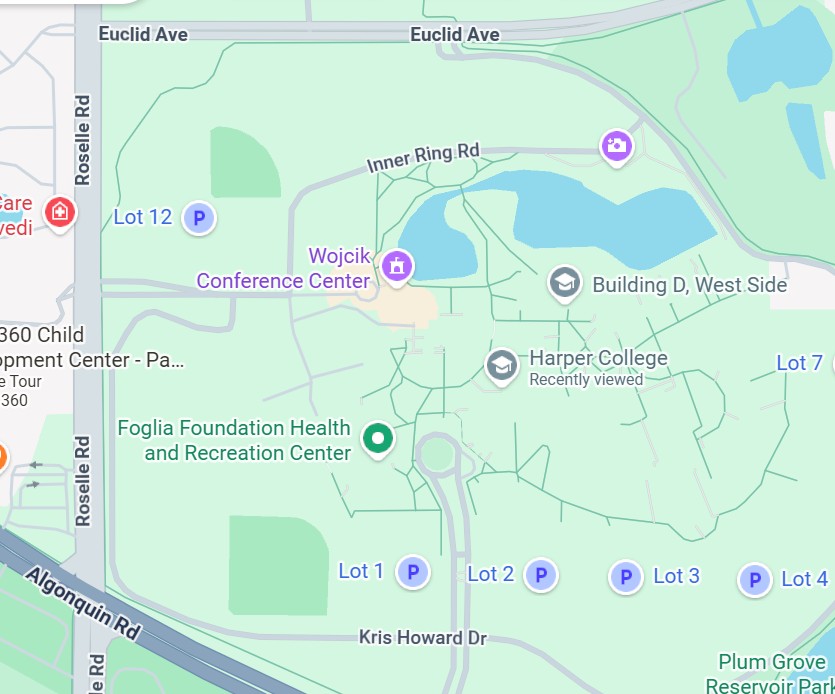
Harper College 1200 W. Algonquin Road Palatine, IL 60067
Harper College is located at the intersection of Algonquin Road (Route 62) and Roselle
Road in Palatine, Illinois. The Wojcik Conference Center can most easily be accessed
through the Roselle entrance. The closest parking lotsare Lot 14 and Lot 13, located directly in front of the Wojcik Conference Center. Parking is free and no
permit is required for event guests. Accessible parking spaces are available near
the main entrance.
Partner Hotels (make sure to request for the Harper rate):