
Harper College will be closed on Monday, September 7, in observance of Labor Day.

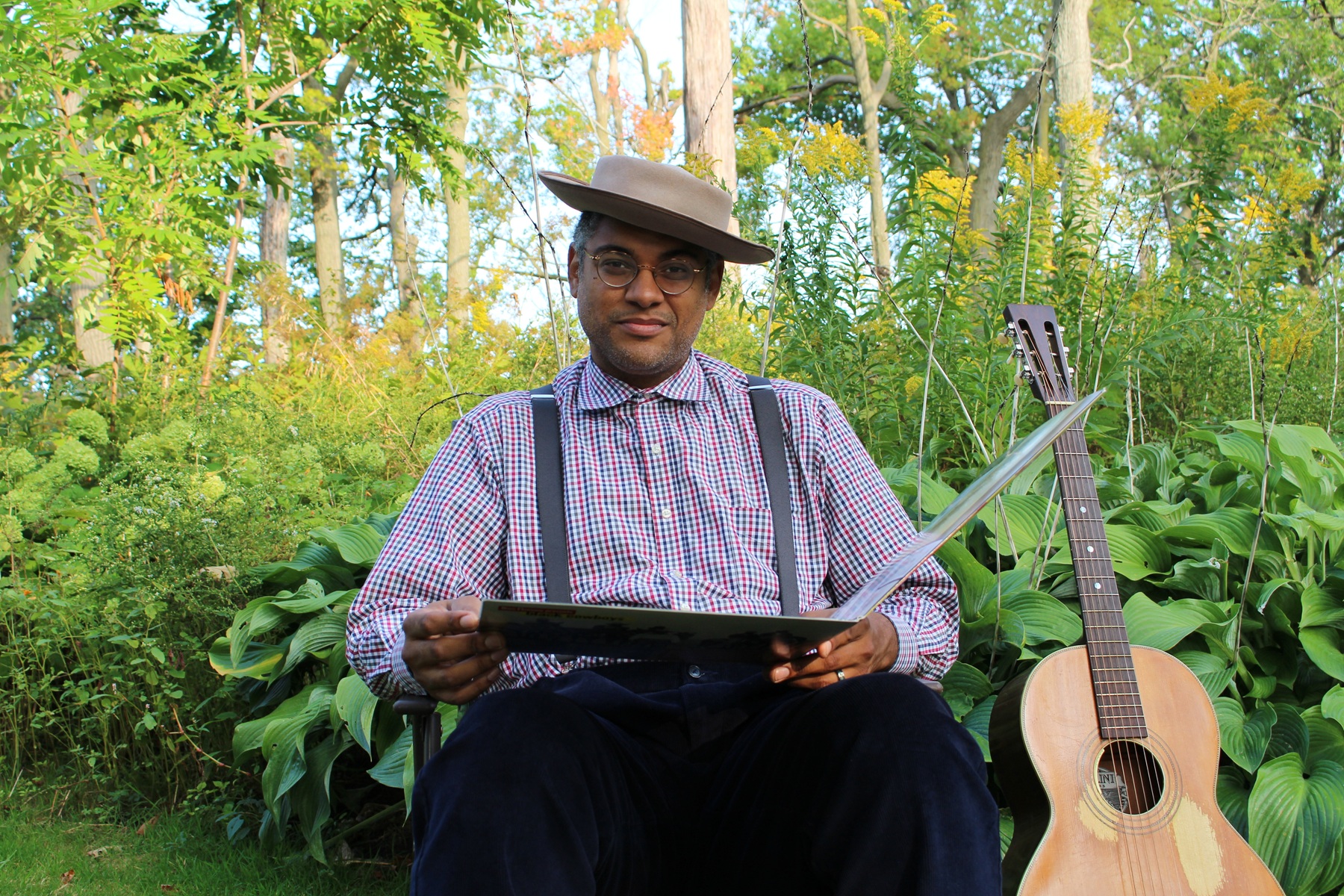
When Dom Flemons takes the stage at Harper College on May 21, he won’t just be performing songs. He’ll be guiding audiences through a broader story about American music and culture – one that involves Black cowboys, segregation-era Hollywood and the extensive roots of country music.
Flemons, the Grammy-winning co-founder of the Carolina Chocolate Drops who tours as a solo artist under the moniker the American Songster, will headline Harper’s inaugural Back Porch Revue Festival, May 21-23. His appearance will include his multimedia presentation The Bronze Buckaroo, inspired by the western film of the same name with an all-Black cast. Flemons will perform selections from his celebrated albums Black Cowboys and Traveling Wildfire in conjunction with footage from the 1939 movie starring Herbert Jeffries.
“I juxtapose what stories the songs tell versus what the visuals are showing. Some musical elements directly feed into what’s on the screen,” he said. “It explores Black cowboys as an idea and how the culture had presented this.”
His Bronze Buckaroo performance begins at noon Thursday, May 21, at Harper’s Performing Arts Center, 1200 W. Algonquin Road, Palatine. Flemons and Vania Kinard – his wife, manager and creative partner – will then discuss how they created these projects at 2:30 p.m. in Building L, Room L109. Admission is free and open to the public for both events.
The festival also celebrates Harper’s own Back Porch Revue, the college’s long-running ensemble dedicated to American roots music. Solo, duo and BPR alumni performances, including former members now performing in the band Amaryllis, will take place at 6:30 p.m. Friday, May 22. A show at 3 p.m. Saturday, May 23, will feature the Back Porch Revue performing a show inspired by the string band music of Flemons and the Carolina Chocolate Drops.
For Scott Cashman, Harper’s senior manager of community, career and corporate education and director of the Back Porch Revue, Flemons represents exactly the kind of artist the group – and by extension, the festival – was built around.
“He covers the whole range of things that happened in the United States,” Cashman said. “His work parallels my own interests in documenting the African American roots of country music and folk music. If you can forget the concept of Black music and white music, our history is much more unified than people understand. Though the music industry often hid the contributions of Black artists, we now know better.”
Cashman, a longtime Flemons fan, connected with the multi-instrumentalist after a concert last year. He was impressed by his ability to educate and entertain.
“He doesn’t assume you have any prior knowledge, but he presents it at such a high level that people who do will have their knowledge deepened,” Cashman said. “And here’s the key thing: It’s fun.”
In addition to being a scholar and songwriter, Flemons is known for his dynamic performances in which he might strum a guitar, pluck a banjo, play the bones or blow on quills (pan pipes). Being an attention-grabbing showman is part of his identity as the American Songster, a term that he resurrected after researching blues music legends.
“When I first started out, I wanted to be a folk singer, but it gave people a certain connotation. They expected an introspective singer-songwriter,” Flemons said. “That wasn’t what I was playing.”
He sings the blues, but not electric/Chicago blues. He plays country music, but not the “modern, pickup truck-type.” And Flemons likes rock ’n’ roll, which can be seen as the anthesis of folk music. He felt that “songster” gave him the opportunity to move fluidly between genres, styles and time periods.
“It allowed me to have some freedoms,” Flemons said. “It doesn’t play to the rules of one form or another.”
That independence, Flemons believes, resonates especially strongly with younger audiences who grew up in a streaming era unconcerned with strict genre divisions.
“Kids will listen to Taylor Swift right next to Muddy Waters and there’s no hypocrisy to it,” he said.
Even as technology transforms how audiences consume music, Flemons sees live performance becoming more valuable, not less. He said that the popularity of podcasts has increased attention spans to the point where people are as interested in his commentary as his music.
“I find that people are really enjoying what I do. The humanness of the music is a strong selling point,” he said. “You can come to a show and see me pull out a guitar. That could be replicated by a machine, but why would you want that?”
Flemons’ appearance is presented by Harper’s Community Education and Cultural Arts Committee. Please note that construction on Harper’s campus is currently obscuring the entrance to the Performing Arts Center (although the entrance is fully accessible by sidewalk). Parking is available in lots 2 and 2A. Visit events.harpercollege.edu for more information.