
Harper College will be closed on Monday, September 7, in observance of Labor Day.

Dr. Stephanie Whalen, director of the Academy for Teaching Excellence and a professor
at Harper College, has helped develop open educational resources to help make textbooks
more accessible to everyone.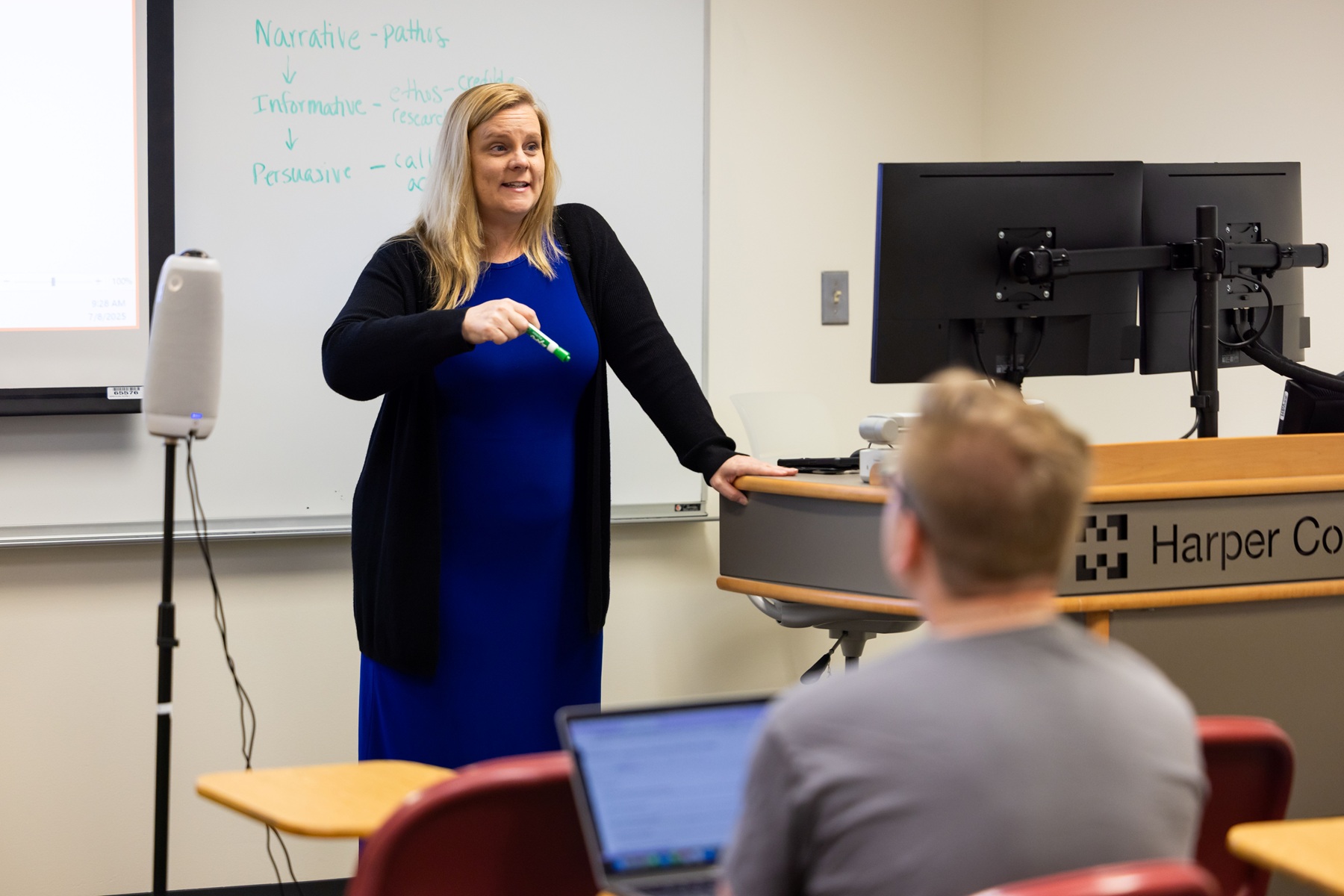
Two-year college students spend $1,302 per year on average for textbooks and supplies, according to the National Center for Education Statistics. Harper College seeks to decrease this cost with the use of free open educational resources (OER).
OERs are openly licensed textbooks and educational materials that can be used at no cost to students. Housed on digital platforms known as OER repositories or libraries, the books and other digital resources are created by educators who can make their own or collaborate with others to design materials entire departments can share.
“We know that large percentages of our students choose not to buy materials even if they’re required because they don’t have the money for it. They need that money for survival, so having no-cost resources that every student can access the first day they’re in class is a huge advantage,” said Joe Wachter, Harper chemistry professor and OER coordinator, who keeps up-to-date with the latest OER releases, manages Harper’s OER platform, Harper PressBooks, and educates faculty on OER use.
In 2018, Harper became one of nine institutions awarded a partnership with OpenStax, a Rice University initiative that provides peer-reviewed digital and print educational materials for all at low or no cost, with the goal of increasing OER use. Several years later, OERs are used in classes in every department at Harper, with large courses like early childhood education, math, psychology and sociology using them almost exclusively.
Dr. Stephanie Whalen, director of the Academy for Teaching Excellence at Harper, has helped develop open educational resources and spreads the word about the advantages of OER use on campus. Whalen, who is also a professor of English and interdisciplinary studies, said one of the important things about OER is that it makes textbooks more accessible to everyone.
“Students can listen to books that are digitally accessible,” she said. “By making texts available to everyone in alternate formats, there’s less of a barrier to accessing them, whether they have an official accommodation or not.”
OERs don’t work well for some subjects and may not be suitable based on the availability of time and resources, Stephanie said, but she is optimistic about the growth of OER use.
“Some faculty have investigated OER for their courses and have not found quality materials or well-supported homework or lab programs that they feel meet their students’ needs,” she said. “Hopefully, faculty will continue to consider options as they become available and potentially find time to author or adapt content.”
A course transformation grant facilitated by the OER work group, a multidisciplinary group of the Faculty Development Committee, covers the cost for Harper instructors to create new OER materials. The Academy for Teaching Excellence offers informational workshops and support for faculty interested in OER, and grants to explore, integrate and update OER materials are available.
Joe said one of the challenges in rolling out OER has been the amount of time it takes to create textbooks or customize materials. He said part of his job as OER coordinator has been making instructors aware of new OER releases or content that is a good fit while highlighting the advantages of OER use.
“There are several big benefits. One would be that they can tailor everything. If they find a paragraph doesn’t work, or a chapter doesn’t work, or a whole half of a book doesn’t work, you can simply change it or cut it out,” he said. “Another big advantage is not having to find accommodations for students when they don’t have access codes for the commercial material because they couldn’t afford the book, and then I would say the third is accessibility. OER materials have been really good about making sure that they are accessible. A lot of those problems go away when you switch to OER.”
Stephanie said using OER materials makes buying books one less thing Harper students have to think about.
“Students don’t have to spend their time trying to research where to best get books from or trying to find an unauthorized copy online, which they often try to do,” she said. “They don’t have to try to buy something that maybe isn’t going to ship right away just so they can save money, so it’s just one more thing that’s not on their list of things that they have to do.”