
Harper College will be closed on Monday, September 7, in observance of Labor Day.

In 'Dirty Turk aka Dirty Immigrant,' three actors play Ozlem (from left, Morgan Smith,
Annie Sauter and Juliette Sadoff) while others portray her grandparents in large,
puppet-like costumes (Zeynep Atayeva as Feride, left, and Aidan Christensen as Tahir).
The show runs March 5-15 at Harper College's Performing Arts Center, 1200 W. Algonquin
Road, Palatine.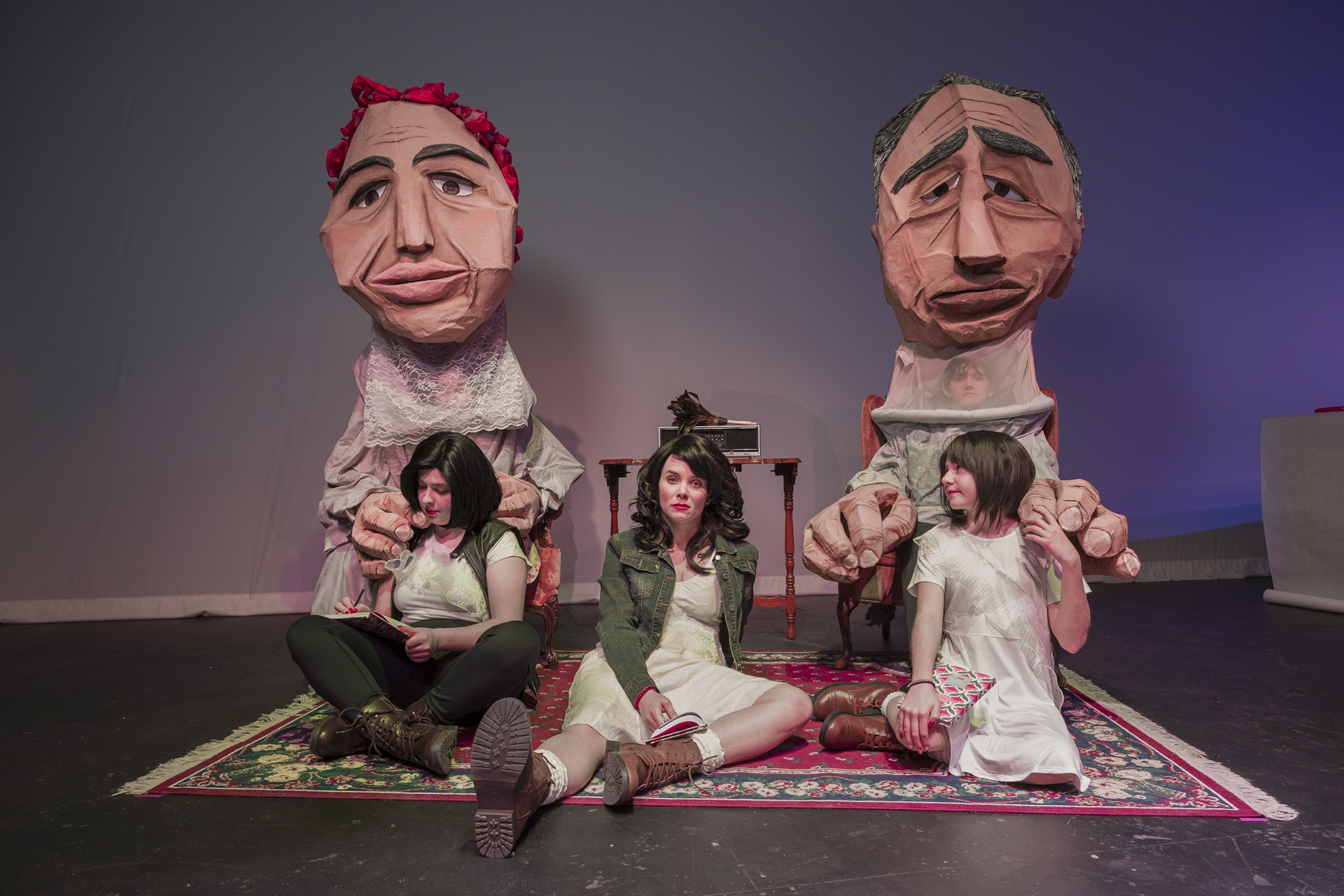
Some plays are written, staged and then preserved as finished works. The Harper College Theatre Ensemble’s upcoming production, Dirty Turk aka Dirty Immigrant, doesn’t work that way.
“I started conceptualizing this play in 2015,” said Ilknür Nilufer Ozgür, who is a Harper Theatre Arts instructor, as well as the writer and director of Dirty Turk. “I never claim to be the sole writer of this. I think of myself as a weaver, because I’m incorporating so many immigrants’ stories and experiences. And we’re still adding to it – 2015 through today – it’s live.”
That living, evolving quality is central to the work’s purpose. Dirty Turk aka Dirty Immigrant, which will be presented March 5-15 at Harper’s Performing Arts Center, 1200 W. Algonquin Road, Palatine, is an immersive production that blends live performance with documentary-style filmmaking, large-scale installation design, projection mapping, puppet-like costumes, original soundscapes and more. The audience will intermingle with the cast among the props and scenery that tell the story of Ozlem, a daughter of Turkish immigrants, and her family. Tickets are $17-27, available via harpercollege.edu/boxoffice or by calling 847.925.6100.
Dirty Turk draws from real-life narratives (Ilknür is also the daughter of Turkish immigrants) and presents Ozlem in three time periods as she wrestles with feeling that she’s not American enough for U.S. society nor Turkish enough for her family. As such, Dirty Turk explores intergenerational experiences of immigrant, migrant and refugee families through themes of survival, identity, resilience and belonging.
'Dirty Turk,' written and directed by Harper alum and Theatre Arts instructor Ilknür
Ozgür, is an immersive production featuring actors Alexandra Halusiak as Ayaz/Attacker,
left, and Annie Sauter as Ozlem.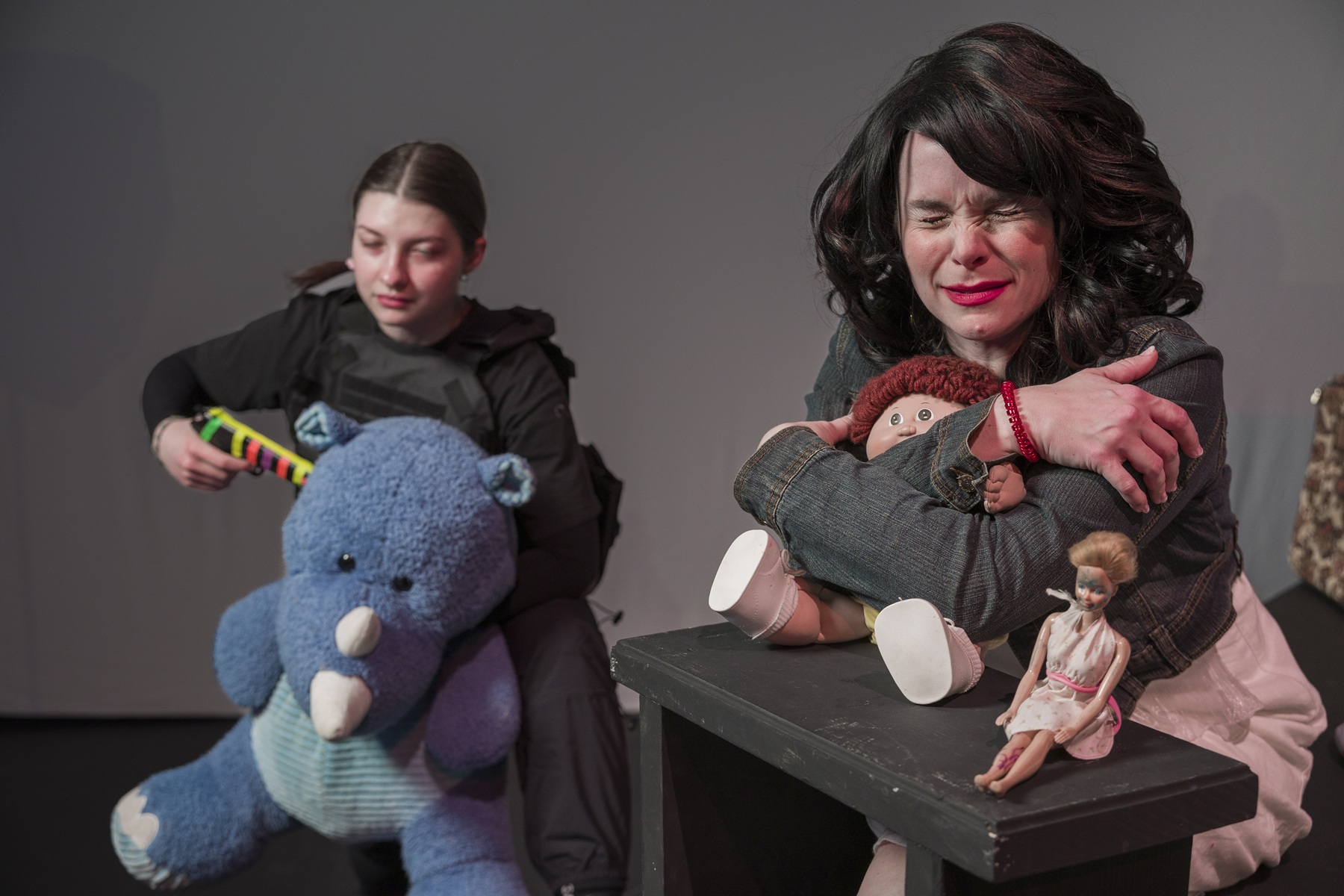
Ilknür is a Harper alum who previous taught theatre and communications at the college on an adjunct basis before relocating to Texas in 2009 and later founding Artstillery, a multidisciplinary arts organization that produces experimental theatrical works with a commitment to social justice.
It was at Artstillery where Ilknür first staged Dirty Turk in 2018 in response to political debates around immigration and the ways those debates reverberate through real lives. The show was revived in 2021 at the Dallas Art Museum and now returns again in 2026 – this time at Harper, where Ilknür herself returned last fall to teach full-time. In the intervening months, she’s spent time making sure the latest incarnation of Dirty Turk incorporates stories from the college’s community.
“It’s so important to weave in several people’s truths,” Ilknür said, acknowledging that current discussions and experiences around immigration in the U.S. play a significant role. “The script is completely evolving – as such to represent what’s happening today. If something tremendous happens culturally, politically, socially… it could be the night before and it will be in the play.”
Ilknür rooted the work in her own family history – particularly her grandparents’ experiences and the way war trauma can echo across generations. But she’s quick to highlight that the play is built to be bigger than one person’s story. The production incorporates experiences of immigrant families, including those who came from Iran, Korea, Russia, Turkiyë, Mexico, Syria and Bulgaria.
“This show is a homage to Harper’s student body,” she said. “I want them to feel seen in the work that I direct on campus. And I want to be seen as a faculty member who holds space for the diversity we have on campus.”
Harper students (and first-time actors) Manaal Khan, left, and Zeynep Atayeva said
they are able to draw upon their own experiences in 'Dirty Turk.' Manaal grew up in
Saudi Arabia and India before studying architecture at Harper. Zeynep came to Harper
from Turkmenistan last year, with the eventual goal of becoming a dentist.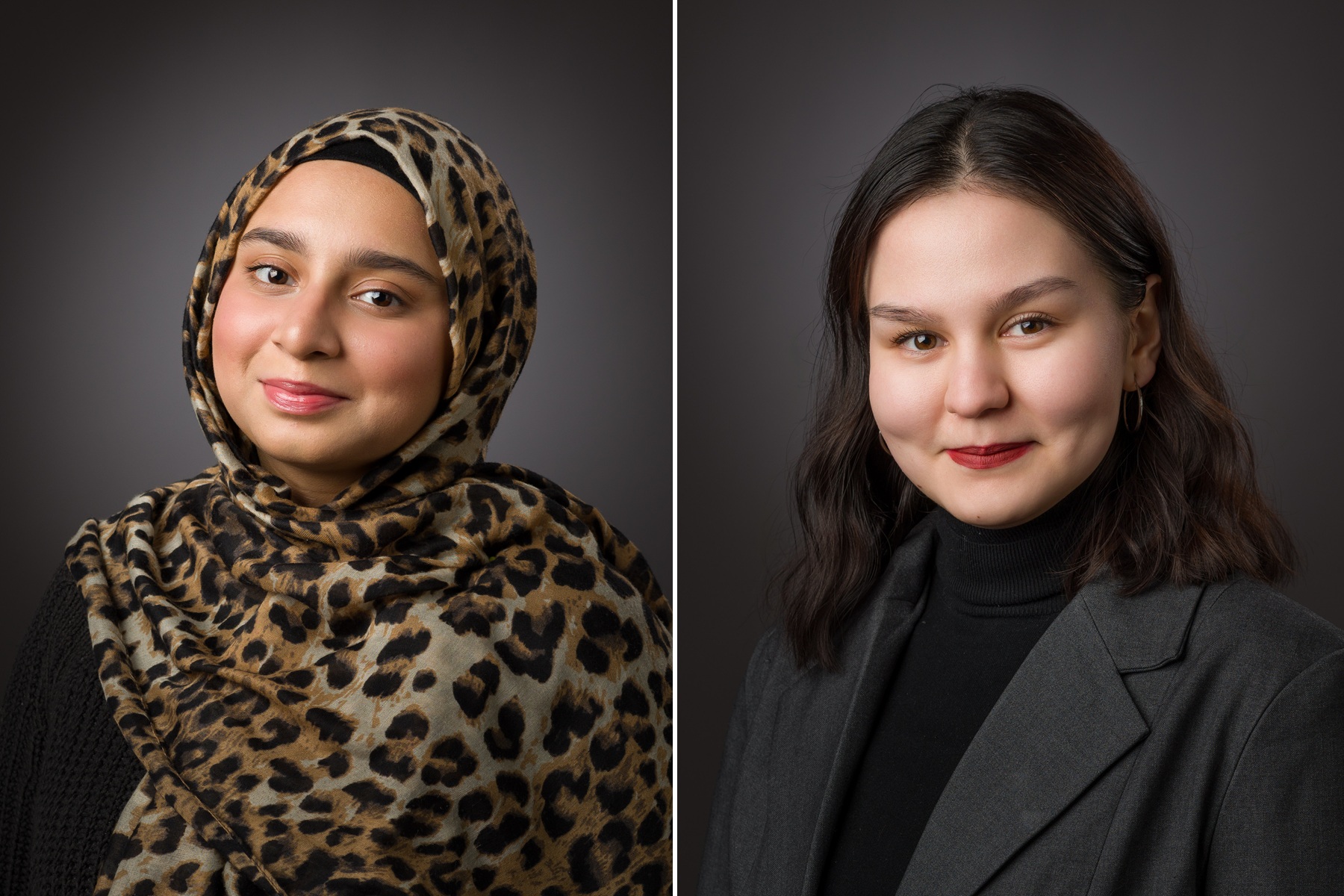
For student actor Manaal Khan, the production is a new experience. Khan, 21, is an international student who started at Harper in 2023. She grew up in Saudi Arabia and attended high school in India before coming to the U.S. and settling with family in Lombard.
“Harper was very welcoming,” she said. “I found my people here.”
Manaal also rediscovered her passion for architecture at the college, with plans to transfer to the University of Illinois Chicago after Harper. She didn’t plan to audition until Ilknür approached her. The two first met in Ilknür’s Speech 101 class, where the instructor mentioned the play and asked if anyone might be interested.
“I never ever acted before in my life. I had no idea what to do,” Manaal said, acknowledging that Ilknür encouraged her to take the leap. “She stopped me and said, ‘I see the potential in you.’”
In Dirty Turk, Manaal portrays an imam, a role that she described as deeply meaningful – particularly because it touches on Islamophobia and fear in the post-9/11 era. She also described how the production uses a welcoming, community-centered image of a mosque.
“In the play, the mosque is shown as an open community space,” she said. “It’s a place where people from different backgrounds can come together, share experiences and support one another. It shouldn’t be seen as something meant only for a certain group, but as a welcoming space that encourages connection, understanding and a sense of belonging for everyone.”
Student actor Zeynep Atayeva, 19, started at Harper in August 2025 and said her first weeks in the U.S. were emotionally overwhelming. She was born and raised in Turkmenistan and came to live with her sister (a student at Loyola University Chicago) in Palatine and pursue an education in the U.S., with the eventual goal of becoming a dentist.
Like Manaal, Zeynep had no prior acting experience, but brings a wealth of visceral experiences as an immigrant experiencing culture shock in America. She also speaks multiple languages, including Turkish, which comes in handy when portraying Feride, the grandmother in the play.
“She’s one of the mentally strongest characters in the play, even though she has so much trauma inside her,” Zeynep said. “Deep inside, she wants to show love, but there’s so much frustration and hidden conflict. Feride reminds me of my own grandmother.”
The role also has a unique theatrical challenge. The grandparents are literally larger than life in Dirty Turk and Zeynep will appear as Feride via a giant, majestic puppet with slightly unwieldy arms. She said the unusual costume helps her connect with the character.
“When I first tried it on, I felt so much like Feride,” Zeynep said. “She’s hiding some of her feelings. As an actor in this costume, I’m hidden too.”
Zeynep and Manaal are bringing their experiences to Dirty Turk, just like their castmates who are Black, white or Latine, those who were born in the U.S. and trace their heritage to myriad countries. Rehearsals have featured a range of emotions that’s just as wide. One moment, the cast and crew are navigating how to responsibly incorporate the harshest of language into a scene, the next, they’re sharing memories of grandparents or laughing about the age gap between those who remember the ’90s and those who were born well after.
A spirit of empathy, sharing and learning is obvious. The cast appears more excited than daunted by performing in this unconventional production with themes about feeling metaphorically dirty as an immigrant. The show’s scope is expansive, but Ilknür emphasized that the heart of the piece is not about shock value – it’s about the everyday experiences of family and community.
“The piece is about love and family and resilience and community and acceptance,” she said. “It’s a safe space for these narratives to be shared in a public arena, when most of these people are whispering.”
For Ilknür, everything works together. The conversations, narrative “weaving,” rehearsals, preparation and immersive performances all create opportunities where immigrant, migrant and refugee stories are not hidden or minimized.
“We are a nation of immigrants,” she said. “We hold our beliefs and value systems close. No matter the culture you come from, we share similar experiences.”