
Harper College will be closed on Monday, September 7, in observance of Labor Day.

Krista Franklin's "Behind the Groove" exhibit, including "I'm Dreaming the Same Thing
Too" (left) will be featured at Harper College's Martha Bell Gallery through March
5. Franklin is also coming to campus for an artist talk and workshop on February 26
as part of Harper's celebration of Black History Month.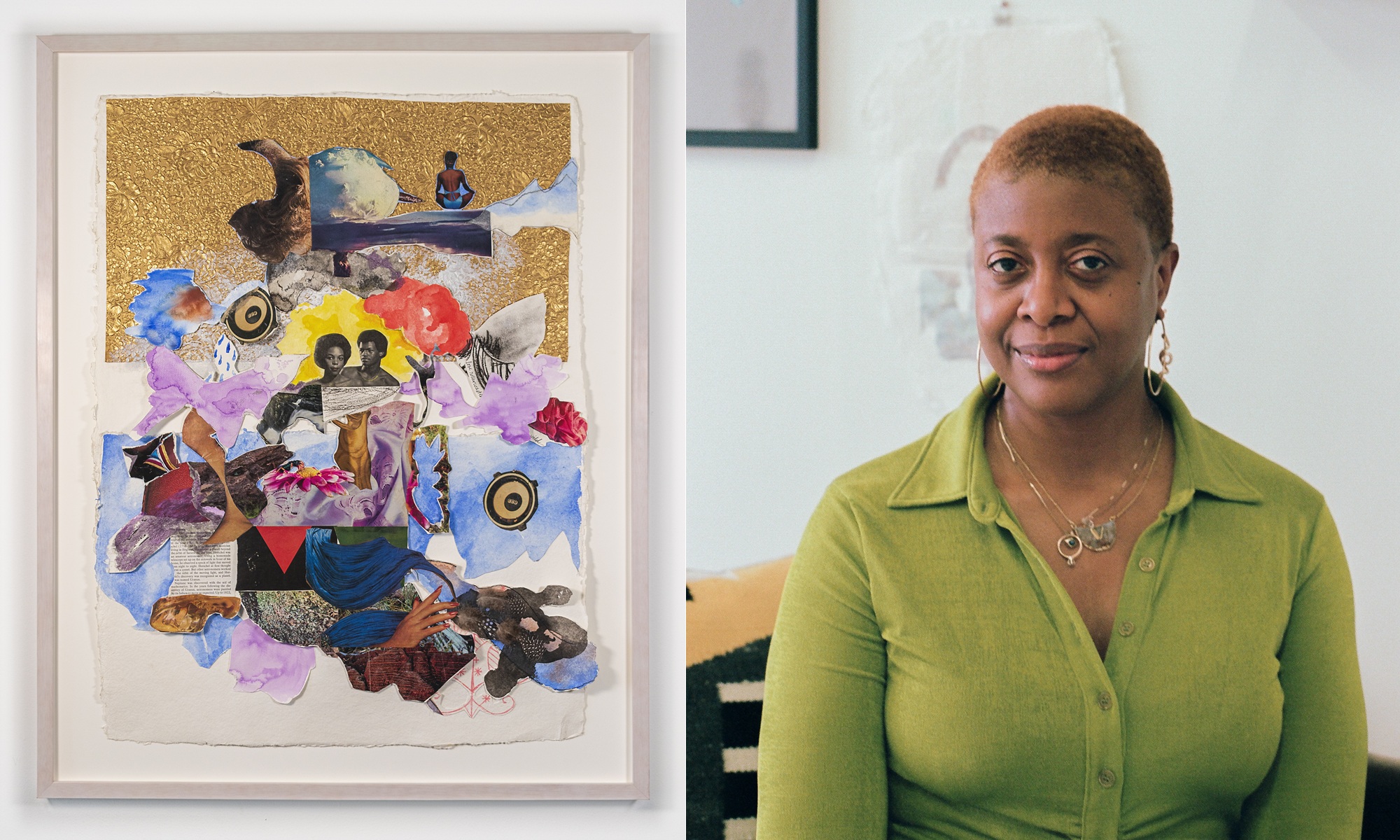
Krista Franklin’s art invites viewers to lean in close and see the seams, the layers and the loving wear that comes with holding things dear. In Behind the Groove, Franklin’s new exhibition at Harper College, many of those items have to do with music: funk, pop and R&B.
The exhibit – which runs through March 5 at the Martha Bell Gallery, Building C, Room C200 on the Palatine campus, 1200 W. Algonquin Road – is infused with the visual language of music culture, where album covers, liner notes and image fragments become both material and memory. All those elements are transformed by Franklin’s talents for collage, composition and papermaking, while spotlighting images of music icons including The Ronettes, George Clinton and Rick James.
“The title Behind the Groove is a reference to a song by Teena Marie,” said Franklin, who is a poet in addition to being a visual artist. “A lot of my titles come from music. Music is a major theme in my work in general, both my writing as well as my visual art. My work kind of orbits around music in a lot of ways.”
Franklin, who is based in Dayton, Ohio, will also be coming to Harper to discuss her art, share her writing and lead a pair of events on Thursday, February 26. Her artist talk at 11:15 a.m. in Building E, Room E108 will be followed by an art workshop at 2 p.m. in the Cultural Center, Building D, Room D281. Those programs are part of Harper’s Black History Month celebration, which includes a variety of events sponsored by the college’s Office of Diversity, Equity and Inclusion, Student Engagement, Black Student Union and Employer Engagement. Events are free and open to all. See the full list of offerings.
Franklin is looking forward to the visit and said she loves to engage in conversations about art, music, history, culture and more. She’s also excited about the opportunity for visitors to participate in an act of creativity during the hands-on workshop.
“I’m holding space for us to create together,” she said. “I think so often we don’t have those moments, especially as adults. Everything is about work, everything is about production, everything is about responsibility, and there is very little space for play. I want this to be a place of exploration of playful concepts, playful ideas.”
The Harper events will also bring Franklin back to the Chicago area, where she lived for 23 years and earned her master’s degree in fine arts from Columbia College Chicago. That’s where she connected with Martinez E-B, an adjunct instructor at Harper who connected Franklin with the college and curated Behind the Groove with her collaboration.
Franklin's "Blessed" (left) and "Lords of the Underground" are both part of the "Behind
the Groove" exhibition at Harper. The artist created the pieces from old album covers
for LPs by The Emotions and Parliament.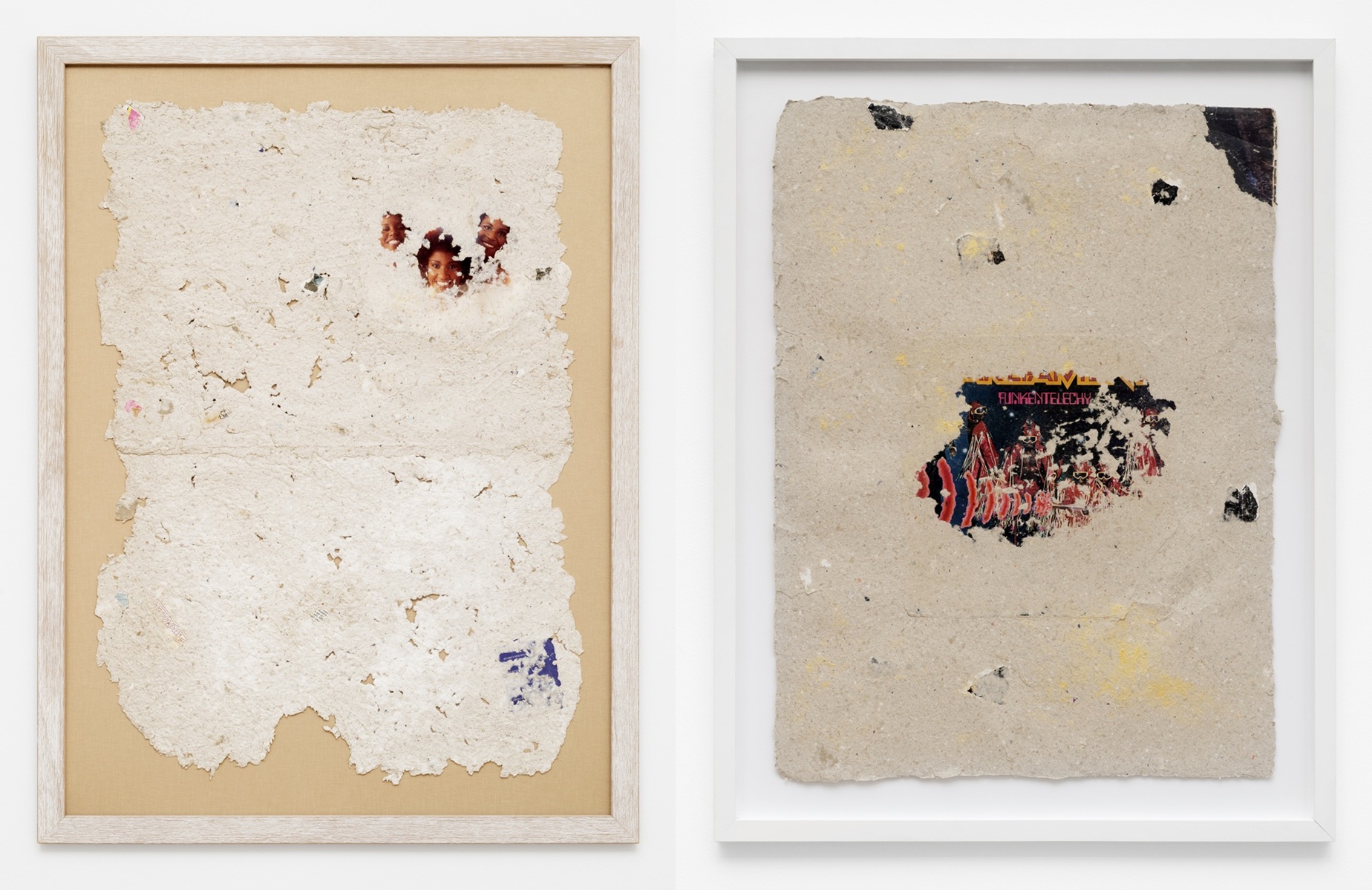
The nearly two dozen pieces in the exhibition, co-sponsored by Harper's DEI Office, range from surrealism to deconstruction and feature kaleidoscopic multimedia collages, handwritten poetry and radically altered album covers. In the case of those covers, which are part of a series called Heavy Rotation, Franklin created handmade paperworks by “pulping down” cardboard sleeves from ’70s LPs by Parliament and The Emotions. Drawing on history – musical, personal, political – is a central focus on Franklin’s art.
“Time is something that’s very important to me. I’m very intrigued with the notion of time as a concept and how I can manipulate time travel through the work,” she said. “We live in a society that is not very interested in history and so the only way to get people to even think about the past is to put something from the past in front of them. Here’s the photographic evidence. Here are the documents… And we have to grapple with that. If we don’t look at the past, we can’t chart the future.”